

How Legacy Logistics Software Limits 3PL Efficiency and Growth

Many third-party logistics providers (3PLs) currently rely on older or custom-developed tools that, while once effective, now struggle to meet contemporary demands for high volume, speed, and clear visibility. What often appears as a functional system typically conceals extensive manual tasks and operational bottlenecks. In an era marked by rising customer expectations and tighter margins, depending on outdated technology is unsustainable. Modernizing your logistics system, upgrading your logistics ERP, and replacing fragmented software are therefore strategic imperatives.

Why Legacy Logistics Software Is Holding 3PL Operations Back
Findings from a worldwide logistics stakeholder survey clearly indicate that obsolete systems and manual operational methods are primary obstacles to achieving efficiency. For 3PL organizations that frequently resort to spreadsheets and temporary fixes to supplement the shortcomings of their aging software, these insights resonate deeply with their everyday operational challenges.
The need for teams to manually cross-reference data across diverse departments—including warehousing, transportation, billing, and finance—results in a steady, unnoticed increase in operational expenditure annually. Such problems are exacerbated when a legacy logistics system lacks proper integration capabilities, making it difficult to interface with client platforms or external carrier networks.
Across many 3PL organizations, manual data reconciliation has become a major drain on operational efficiency. Teams spend excessive hours validating data, resolving discrepancies, and correcting billing errors per shipment—tasks ideally automated in a modern logistics setting. These inefficiencies not only increase cost-to-serve but also hinder decision-making and slow issue resolution. This operational drag steadily diminishes customer confidence through inconsistent service reliability. For a deeper understanding of how modern solutions can transform these challenges, consider exploring Logibrisk’s offerings.
Numerous research and expert evaluations highlight the strategic imperative of adopting real-time, cloud-centric ERP and supply chain management platforms. These solutions are vital for consolidating diverse data streams, automating operational processes, and providing live order tracking and enhanced transparency.
Innovation barriers further widen this gap. Older logistics software architectures, designed before mobile workflows, event-driven planning, or API-first ecosystems, make even minor upgrades slow and costly. Analyses on digital adoption in logistics consistently show that businesses using legacy tools lag in automation, analytics, and modern compliance. To understand the journey towards digital adoption in logistics, and how companies like Logibrisk are pioneering new paths, it’s clear that businesses relying on legacy tools consistently lag.

The Operational and Financial Impact of Legacy Logistics Software on 3PLs
The repercussions of depending on antiquated 3PL systems are primarily manifested in diminished service performance. According to a study, a substantial percentage of 3PLs identify technological deficiencies as a key factor contributing to failures in meeting service-level agreements and overall customer discontent.
Concurrently, operational costs escalate rapidly. Lacking adequate automation, a 3PL is often compelled to increase headcount simply to sustain operational throughput, thereby shrinking profit margins. Furthermore, the upkeep expenses for older systems—including necessary patches, bug fixes, and bespoke coding—silently deplete IT budgets and hinder overall productivity.
The ability to scale is also severely compromised. Traditional IT infrastructures are typically designed for fixed, localized operations, inherently lacking the adaptability and capacity to expand into diverse geographical regions, each with unique regulatory frameworks, operational demands, and customer expectations. With increasing market pressures for omnichannel fulfillment, complex multi-site coordination, and expedited billing processes, legacy 3PL systems increasingly become restrictive bottlenecks.
For 3PLs handling substantial volumes, even minor increases in error rates or extended billing cycles can rapidly lead to considerable margin erosion. As client expectations evolve towards comprehensive omnichannel fulfillment, intricate multi-site management, and almost instantaneous billing, legacy systems transform into fundamental impediments. They impede operational speed, limit expansion capabilities, and reduce a 3PL’s capacity to react to dynamic market demands with promptness and accuracy.
Replacing Legacy Logistics Software with a Modern Logistics ERP
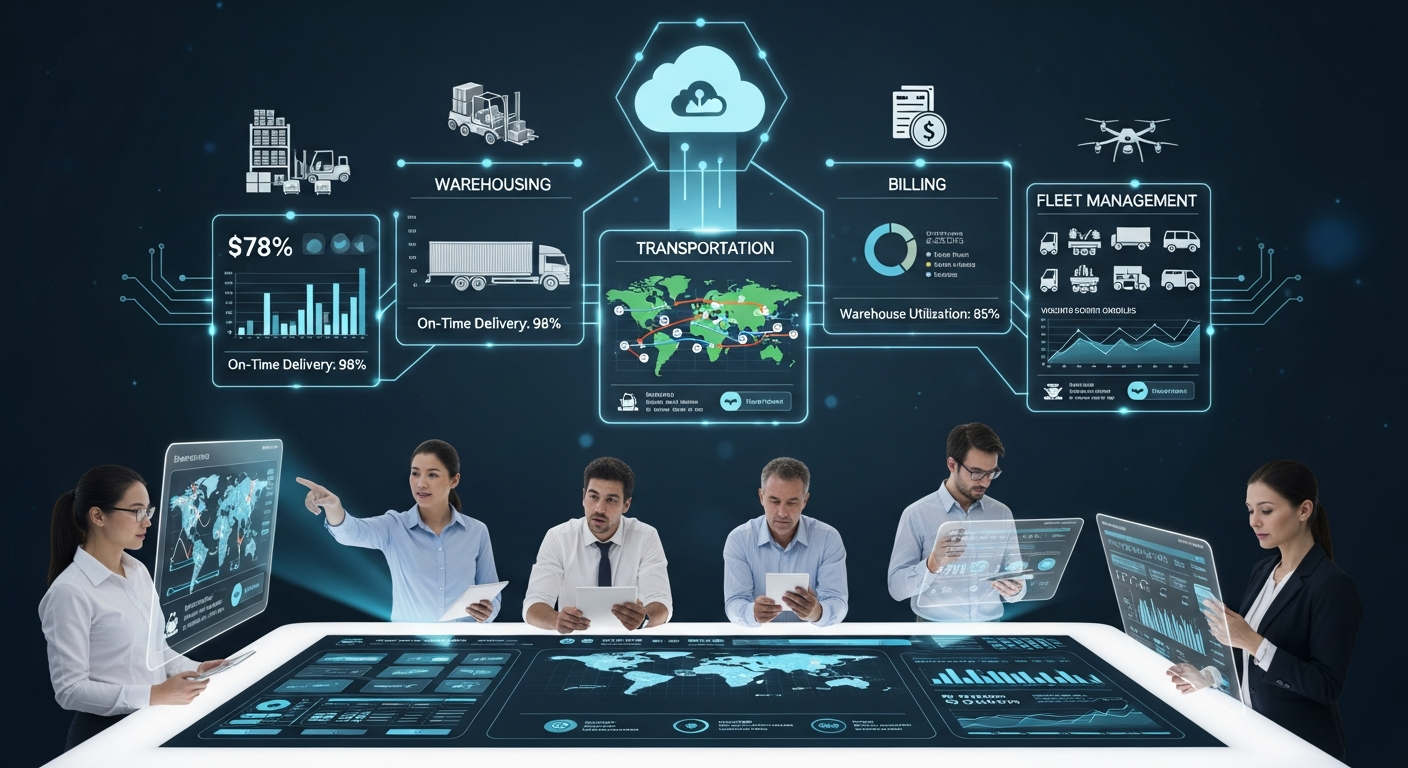
The viable alternative lies in adopting a unified, enterprise-level platform that integrates warehousing, transportation, billing, fleet management, and financial operations into a single, cohesive logistics ERP. Ramco’s comprehensive logistics suite is specifically engineered to address the complexities of this modern operational environment.
- Unified Operations: A singular, enterprise-grade platform centralizing transportation, warehouse, hub, fleet, and billing with shared contracts and tariffs. This eliminates redundancy, reduces silos, and ensures consistent operations.
- Mobility & Automation: Role-specific mobile applications empower drivers, warehouse operators, and hub supervisors with real-time ePOD, guided navigation, automated task execution, and on-the-go visibility, drastically cutting manual paperwork.
- Ecosystem Integration: An API-first architecture with ready connectors to carrier systems, customer ERPs, e-commerce platforms, telematics, and IoT devices guarantees seamless data flow. This interoperability integrates 3PLs into a broader, real-time logistics ecosystem.
- Revenue Protection: A rules-driven rating and billing engine minimizes revenue leakage, improves auditability, and speeds up invoice processing. This enhances financial control and ensures accurate billing for every service, echoing the importance of precise financial management as seen in areas like payroll compliance and automation.
When 3PLs Should Move Away from Legacy Logistics Software
For 3PLs facing recurring SLA breaches, heavy manual workloads, and slow customer onboarding, delaying modernization only amplifies these issues. Competitors leveraging digital-first logistics or ERP systems are gaining speed, offering more consistent service, and scaling efficiently. A phased migration to a modern logistics ERP, such as Ramco’s platform, helps 3PLs de-risk the transition from outdated systems while securing quick operational wins. This strategy not only delivers immediate value but also builds the digital foundation for sustainable logistics transformation.