
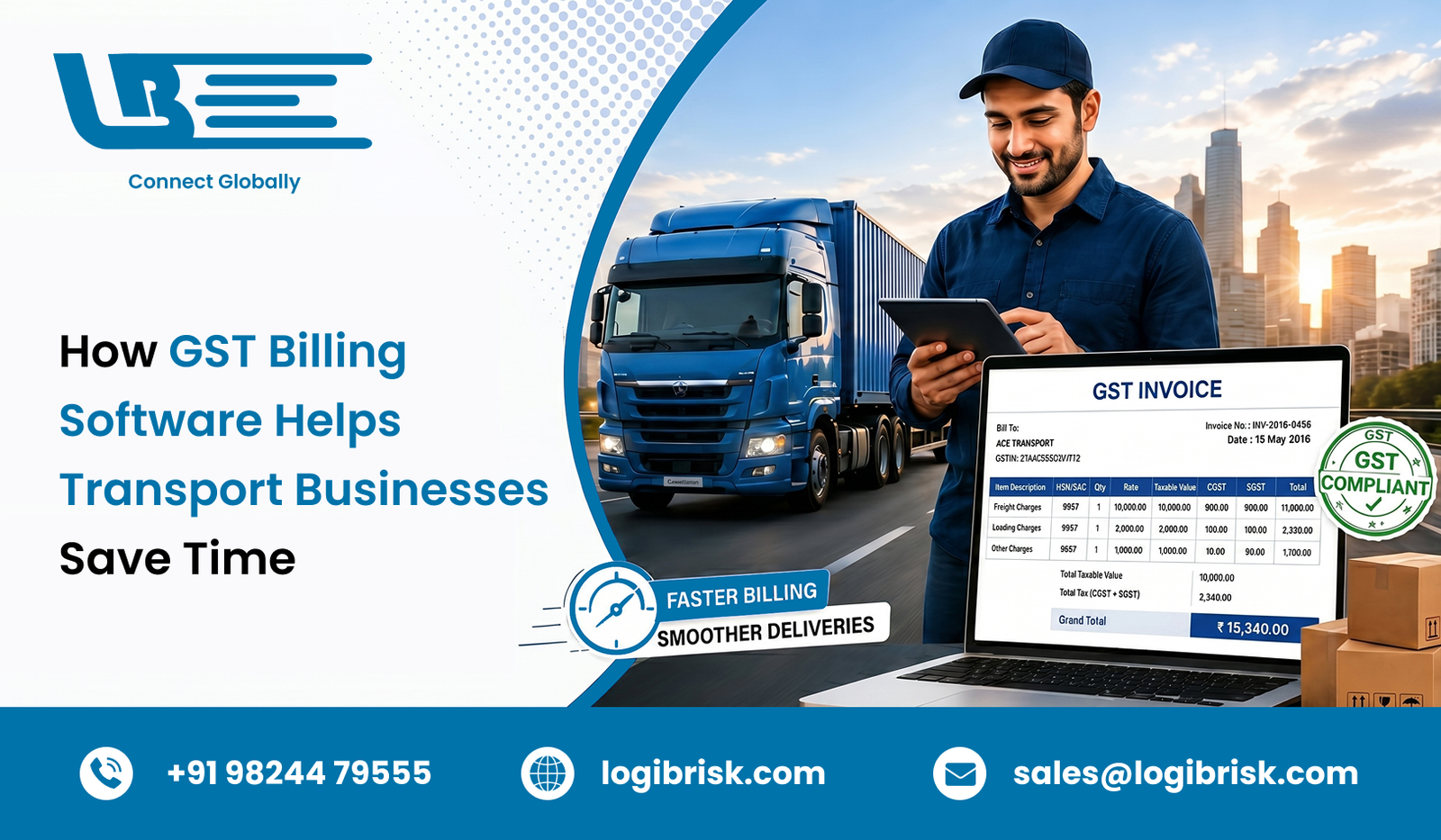
How GST Billing Software Helps Transport Businesses Save Time
Running a transport business in India has always required sharp operational efficiency. But in 2026, there is one more thing it demands: near-perfect GST compliance.
The rules have changed significantly. From April 2025, businesses with an Annual Aggregate Turnover of ₹10 crore or more must submit e-invoices to the Invoice Registration Portal within 30 days of the invoice date. Miss that deadline, and the invoice becomes invalid for GST purposes, your client cannot claim Input Tax Credit, and you face penalties under Section 122 of the CGST Act. From July 2025, GSTR-3B is auto-populated from e-invoice data, meaning any discrepancy between your uploaded invoices and filed returns is immediately visible to the GST system. No manual adjustments. No room for “close enough.”
For transport businesses managing dozens of invoices a day across multiple clients, routes, and rate cards, manually handling all of this is no longer just inefficient. It is genuinely risky.
That is where GST billing software makes an immediate, measurable difference. Businesses across India are switching to GST invoice software. India’s transport companies can rely on platforms that automate invoice creation, apply the correct tax rates, and maintain clean compliance records without manual effort. This guide explains what it is, the problems it solves, and how it saves transport businesses time every day.
What is GST Billing Software?
GST billing software is a platform that automates the creation, management, and filing of GST enabled transport software, applying the correct tax rates, generating the required documents, and keeping your records ready for filing without manual intervention. For Indian logistics companies, a proper transport billing software goes further, connecting trip data, freight rates, E-Way Bills, and client billing cycles into one automated process.
For a transport business, this means every invoice raised for a completed trip automatically carries the correct HSN code, the right GST rate for the service type, the applicable E-Way Bill reference, and all mandatory fields under GST law. The moment a delivery is confirmed, the invoice is ready. No manual calculation, no cross-checking rate cards, no last-minute scramble before filing day.
Think of it as the billing department that never makes errors and never forgets a deadline.
GST Billing Challenges Transport Businesses Face Daily
Before getting into what the software does, it helps to understand what manual billing actually costs transport businesses:
Wrong GST Rates on Invoices
Transport businesses often apply incorrect GST rates because different transport services follow different tax rules. GST treatment also changes based on GTA, non-GTA, and reverse charge conditions. Even small mistakes can create invoice mismatches and compliance issues.
Penalty Exposure on Incorrect Invoices
Incorrect GST invoices can lead to financial penalties for transport businesses. Companies handling large numbers of invoices every month face a higher risk when billing errors occur regularly. Small mistakes in invoicing can slowly turn into major financial losses.
GSTR-3B Auto-Population Issues
GSTR-3B now directly uses uploaded invoice data, leaving little room for manual corrections later. Any mismatch between invoices and returns becomes visible immediately during filing. Businesses still using manual billing often struggle with reconciliation problems.
Multi-Client Rate Card Complexity
Different clients usually have different freight rates, billing cycles, and GST requirements. Managing all this manually through spreadsheets increases confusion and billing errors. A freight billing software helps transport businesses automate rate calculations and reduce manual checking.
Payment Follow-Up Without Proper Visibility
Transport firms have a lot of problems with tracking pending payments with manual record-keeping. Payment follow-ups usually depend on calls, WhatsApp chats, or scattered files. This delays the collection and visibility of cash.
Month-End GSTR Filing Pressure
Preparing invoice data manually for GSTR filing becomes stressful at the end of every month. Teams spend hours matching records, checking invoices, and correcting mistakes. Many transport businesses also rely heavily on accountants for final filing work.
How GST Billing Software Saves Time for Transporters
Automated Invoice Generation
The most direct time saving happens at invoice creation. A good GST invoice software generates the invoice automatically the moment a trip is completed, pulling the client details, agreed rate, applicable GST rate, HSN code, and E-Way Bill reference from the trip record.
No one needs to sit down and manually build the invoice. No one needs to look up the rate card or remember whether this client is billed at the end of the week or the end of the month. The system handles it, and the invoice is accurate every time.
GST Rate Auto-Application
Transport services in India involve nuanced GST treatment. GTA services, freight forwarding, courier services, and reverse charge scenarios all carry different rates. Manually selecting the correct rate for every invoice is a daily compliance risk.
GST billing software applies the correct rate automatically based on the service type and client configuration. The correct HSN code is filled in without anyone looking it up. This alone eliminates one of the most common sources of invoice errors in Indian transport billing.
GSTR Filing Made Easy
Delayed filing can result in late fees, interest, and compliance risks, and small businesses should automate GST billing and reconciliation wherever possible.
Good GST billing software keeps your GSTR-1 and GSTR-3B data ready throughout the month, not just at the end of it. Every invoice raised is automatically categorised and compiled into filing-ready reports. When filing day arrives, it is a matter of reviewing and submitting, not assembling data from ten different places under time pressure.
For transport businesses that currently pay a CA to handle basic GST filing tasks, this significantly reduces that dependency and its associated cost.
Payment Tracking and Follow-Up
Outstanding payments are one of the biggest cash flow problems in Indian logistics. GST billing software gives your team a live dashboard of every invoice paid, pending, and overdue, with automated payment reminders going out to clients at pre-set intervals.
Instead of manually tracking who owes what and making phone calls to follow up, your team sees the complete picture in one place and the system handles routine reminders automatically. Collections become more systematic, and cash flow becomes more predictable.
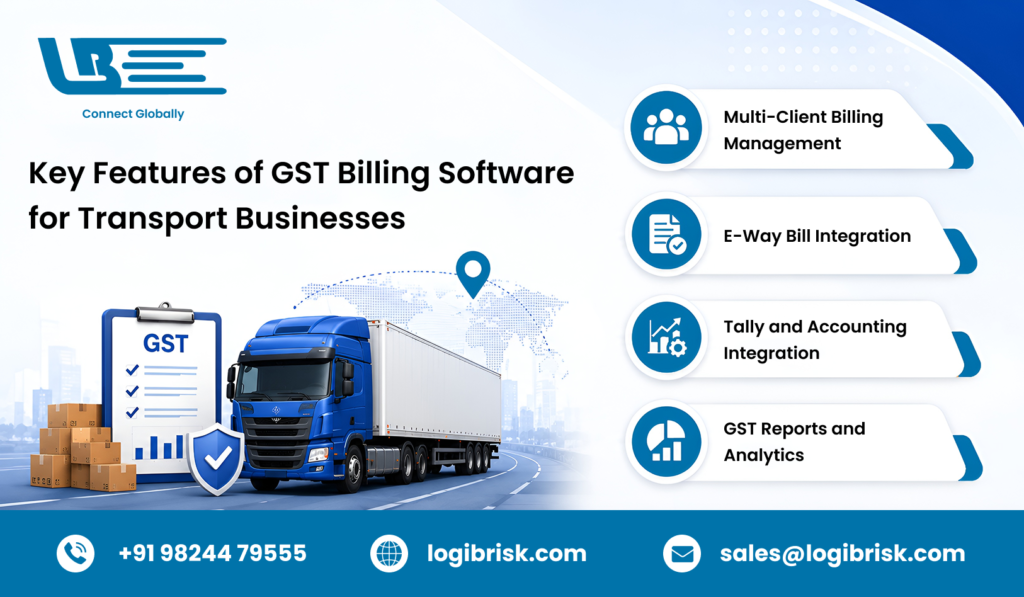
Key Features of GST Billing Software for Transport Businesses
Multi-Client Billing Management
Transport businesses typically work with multiple clients, each with different rate cards, billing cycles, and reporting needs. GST billing software manages all of this separately, maintaining each client’s agreed rates, generating invoices on the correct schedule, and producing consolidated or client-specific reports on demand. What previously required separate Excel files for each client runs from one dashboard.
E-Way Bill Integration
Every invoice for a qualifying consignment needs a corresponding E-Way Bill. In a manual setup, these are generated separately, adding a step and a potential mismatch between invoice and E-Way Bill data. With integrated GST billing software, the E-Way Bill is generated as part of the invoice creation process, with the same data, same record, zero mismatch risk.
Tally and Accounting Integration
For transport businesses already using Tally for accounting management software, the billing software should sync directly, pushing confirmed invoice data into Tally without manual re-entry. A proper GST accounting software integration keeps your books updated in real time and ensures your accounting records match your billing records without a reconciliation exercise at the end of the month.
GST Reports and Analytics
Beyond invoice generation, the software produces GSTR-1 and GSTR-3 B-ready reports, tax liability summaries, ITC tracking, and real-time revenue dashboards. Your finance team stops assembling reports manually and starts reviewing data that the system has already organised.
Benefits of GST Billing Software for Transport Businesses
The shift from manual to automated GST billing produces measurable results quickly:
- Faster Invoice Generation: What takes 10-15 minutes manually takes seconds with automated billing
- Reduced GST Errors: Auto-applied rates and HSN codes remove the most common source of billing mistakes
- Lower Penalty Risk: Accurate invoices, on-time E-Way Bills, and filing-ready data mean no exposure to GST penalties
- Improved Cash Flow: Faster invoicing and automated payment reminders mean shorter collection cycles
- Month-End GST Filing Simplified: Filing-ready data throughout the month makes GSTR submission a simple review, not a stressful exercise
- Simplified Multi-Client Billing: Manage multiple client billing easily with logistics billing software India businesses use for automated rate cards, GST, and billing cycles.
Who Needs GST Billing Software Most?
Some transport businesses feel the pain of manual billing more acutely than others:
FTL and PTL operations
FTL and PTL operations generate large numbers of trips and invoices every day. Manual billing processes become difficult to manage as operations scale.
Express cargo companies
A fast turnaround on deliveries requires a fast turnaround on invoices. For businesses managing express cargo, manual billing creates a lag between delivery and invoice that directly slows collections and impacts daily cash flow.
3PL logistics providers
Managing billing across multiple clients with different rate structures and reporting requirements is only practical with a centralised automated system.
Fleet owners
Once you cross this threshold, manually tracking invoices, payments, and GST filing for every trip becomes a full-time job. When fleet management software India connects directly with billing, every completed trip auto-triggers an invoice without your team manually initiating it.
Last-mile delivery companies
High delivery volumes with COD reconciliation and client-specific billing cycles make automated GST billing essential for operational clarity.
Manual Billing vs GST Billing Software
| Factor | Manual Billing | GST Billing Software |
| Invoice generation | Hours manual entry | Minutes automatic |
| GST rate errors | Common risk | Zero auto-applied |
| GSTR filing | Manual error-prone | Filing-ready data always available |
| Payment tracking | Excel/phone calls | Live dashboard auto reminders |
| Multi-client billing | Complex separate files | Simple managed in one place |
| Audit readiness | Scramble at year end | Always ready |
How to Choose the Right GST Billing Software for Transport
Not all billing software is built for the specific needs of Indian transport operations. Here is what actually matters:
- Transport-specific billing: Generic billing software often lacks transport-specific billing features. Transport businesses need software built for freight, GST, ODC movement management software, and trip-based operations.
- E-Way Bill integration: Invoice and E-Way Bill must generate from the same data. Separate tools mean separate data entry and mismatch risk.
- Tally integration: Direct sync with your accounting system eliminates duplicate data entry and keeps books accurate in real time.
- GSTR-1 and GSTR-3B auto reports: Filing-ready reports should be available at any time, not just at month-end.
- Cloud-based platform: Access from office, on the road, or from home. Cloud also means automatic compliance updates when GST rules change, without you having to do anything.
- Fast onboarding: The right provider should have you live within a week, handling setup and training so your team does not lose time during the transition.
Why Transport Businesses Choose Logibrisk
Logibrisk is built specifically for Indian transport businesses, making GST billing, trip invoicing, and E-Way Bill management simple and automated. The system connects billing with trip management, dispatch, delivery management software, and Tally integration for smoother daily operations.
With 1 Billion+ shipments completed and 500+ enterprises across India, Logibrisk supports transport businesses of every size. Setup is completed within 5 working days, helping teams start faster and manage billing more efficiently from day one.
Conclusion
GST compliance in India is only getting more automated and more stringent. In 2026, the gap between transport businesses using proper billing software and those still managing invoices manually is not just an operational difference it is a compliance risk that shows up in penalties, blocked ITC, and failed audits.
GST billing software does not just save time. It removes a category of risk from your business entirely by making accurate, compliant invoicing the default outcome of every completed trip, not something your team has to manually ensure.
Indian transport businesses are still wasting hours on manual GST billing and risking penalties every single month. Get a Free Consultation with Logibrisk and see how GST billing software saves time and keeps your business compliant from day one.
FAQs
Q1: What is GST billing software for transport?
It is a platform that automates invoice creation, GST rate application, E-Way Bill integration, payment tracking, and GSTR filing preparation specifically for transport and logistics businesses operating under India’s GST regime.
Q2: How does GST billing software save time for transporters?
It generates invoices automatically from trip data, applies correct GST rates without manual input, compiles filing-ready data throughout the month, and sends payment reminders automatically, eliminating most of the manual work involved in transport billing.
Q3: Can GST billing software integrate with Tally?
Yes. Good transport billing software like Logibrisk syncs directly with Tally, pushing confirmed invoice data into your accounts without manual re-entry or end-of-month reconciliation exercises.
Q4: Is GST billing software suitable for small transport businesses?
Absolutely. Even transport businesses with 5 to 10 vehicles benefit significantly from automated billing. The elimination of errors, penalty risks, and the time wasted on manual invoicing quickly offsets the cost of the software.
Q5: How quickly can I implement GST billing software?
With Logibrisk, transport businesses go live within 5 working days. The team handles system configuration, client rate card setup, and staff training as part of the onboarding process.