
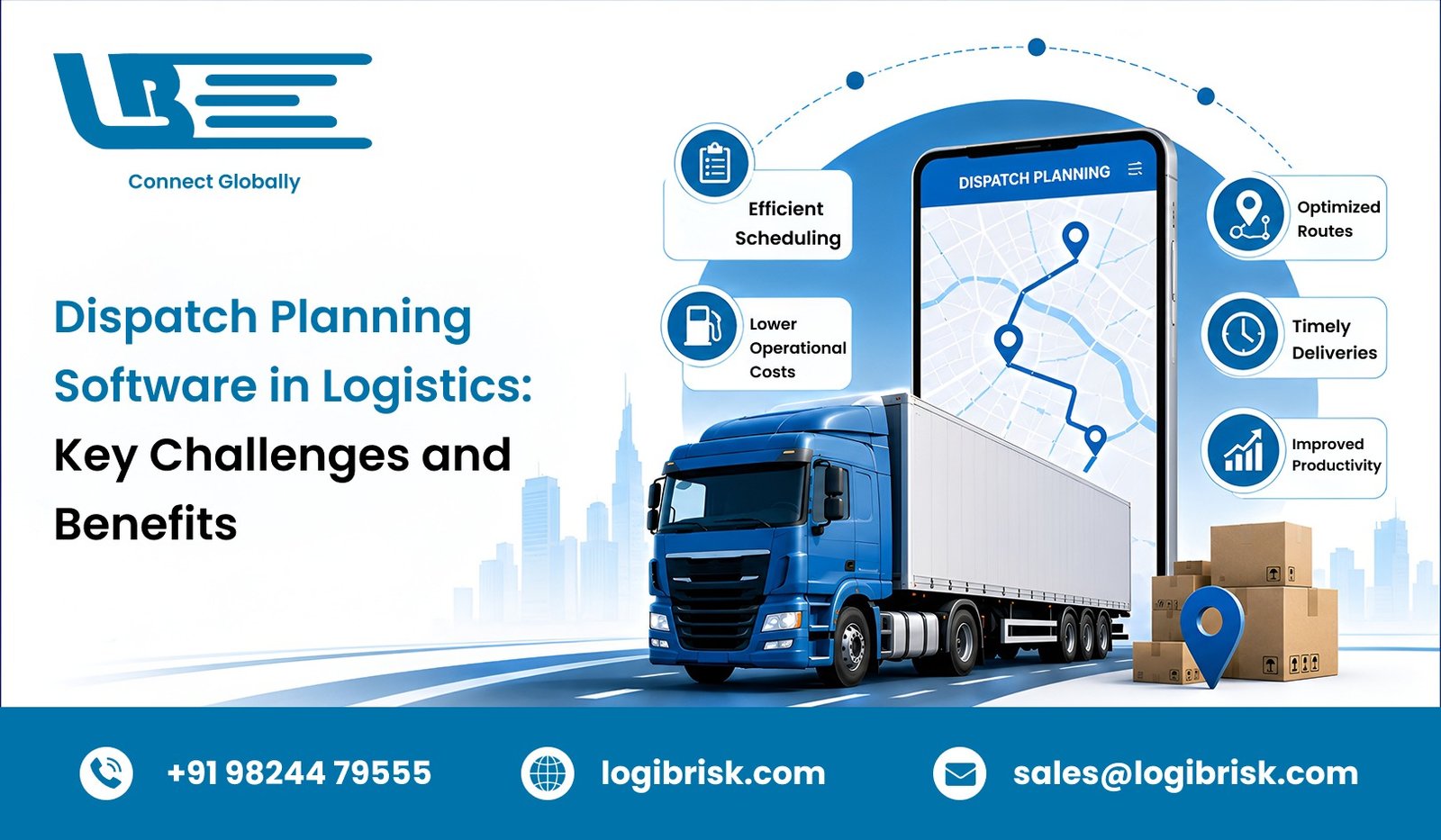
Dispatch Planning Software in Logistics: Key Challenges and Benefits
Every morning in a logistics company, the same scene plays out. A dispatcher sits down with a list of orders, a fleet status spreadsheet, a WhatsApp group full of driver messages, and a phone that will not stop ringing. Vehicles need to be assigned. Routes need to be decided. Drivers need to be briefed. Clients need ETAs.
Sorting all of this information can take an hour or two. As a result, some trucks leave without complete instructions, a few drivers continue waiting for confirmation, and delivery delays begin to build early in the day.
This is what manual dispatch planning looks like. And in 2026, with India’s logistics industry valued at over USD 228 billion and growing at 7.7% CAGR, it is a process that simply cannot keep up with the scale and speed modern logistics demands.
Dispatch planning software solves this not by adding more people to the process, but by automating the coordination that currently consumes your team’s time every single day. Businesses across India are switching to automated dispatch software India logistics companies rely on platforms that assign vehicles, optimise routes, and push instructions to drivers automatically, without manual intervention. This guide breaks down the key challenges of logistics dispatch planning and exactly how the right software addresses them.
What is Dispatch Planning Software?
Dispatch planning software is a platform that automates the assignment of vehicles, drivers, and routes to delivery orders in real time, based on live data about your fleet, your loads, and your delivery requirements. Think of it as a complete logistics dispatch management system, one that replaces the morning chaos of manual coordination with an automated process that runs accurately and consistently at any scale.
In a manual setup, a dispatcher makes these decisions based on experience, partial information, and a lot of phone calls. In a software-driven setup, the system analyses available vehicles, driver availability, load requirements, delivery time windows, and route efficiency simultaneously. As a result, it automatically assigns the optimal vehicle and driver combination for each shipment.
Consequently, businesses benefit from faster dispatch, fewer errors, improved fleet utilisation, and a dispatch team that can focus on managing exceptions rather than coordinating routine assignments.
How Dispatch Planning Software Works
The process runs as a connected loop once the system is in place:
- Orders Loaded: Delivery orders are entered manually or synced automatically from your existing systems. All shipment details are stored in one central platform.
- Vehicle and Driver Assignment: The system automatically assigns the most suitable vehicle and driver based on availability and delivery requirements.
- Route Optimised: An optimised route is generated and sent directly to the driver’s mobile app with complete trip details.
- Real-Time Tracking: Once the trip starts, live vehicle tracking provides complete visibility to the operations team.
- Delivery and Billing Triggered: Digital proof of delivery is captured, and the invoice process begins automatically without manual intervention.
Key Challenges in Logistics Dispatch Planning
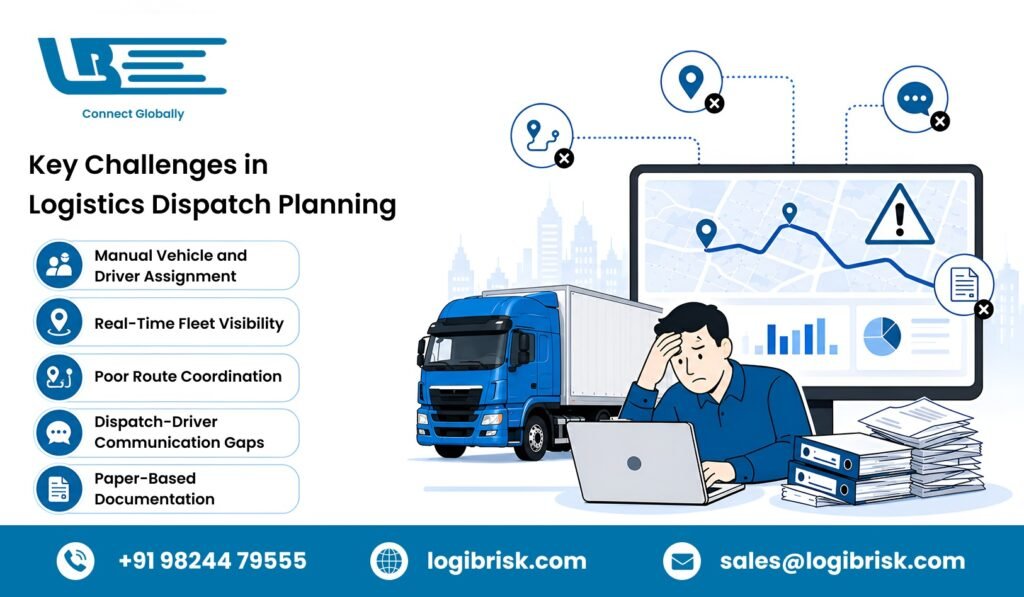
Manual Vehicle and Driver Assignment
Manually assigning vehicles and drivers requires checking availability, capacity, and delivery requirements for every trip. This process is time-consuming and increases the risk of incorrect assignments. Last-minute changes can further disrupt schedules and delay dispatch operations.
Real-Time Fleet Visibility
Without real-time tracking, dispatchers rely on phone calls and manual updates to monitor fleet movements. This makes it difficult to identify delays, reroute vehicles, or respond quickly to unexpected issues. Limited visibility often leads to slower decision-making. A dispatch management system provides live fleet visibility from a single dashboard.
Poor Route Coordination
Manual route planning often results in inefficient routes, unnecessary mileage, and longer delivery times. Drivers may encounter avoidable traffic or take less efficient paths. These inefficiencies increase fuel costs and reduce overall productivity, especially when compared to using E-commerce Delivery Management Software, which helps optimize routes, reduce delays, and improve delivery efficiency.
Dispatch-Driver Communication Gaps
When communication depends on phone calls and messages, important updates can be missed or misunderstood. Delivery changes, route updates, and urgent instructions may not reach drivers on time. This can lead to delays and service disruptions.
Paper-Based Documentation
Managing trip sheets, delivery records, and proof of delivery on paper creates additional administrative work. Documents can be delayed, misplaced, or difficult to retrieve when needed. As a result, billing and invoicing processes often slow down.
Key Benefits of Dispatch Planning Software
Intelligent Resource Assignment
The system automatically matches available vehicles and drivers with delivery requirements. This reduces manual coordination and speeds up dispatch planning. Assignments are completed in seconds instead of hours. It also helps minimize scheduling errors and delays.
Real-Time Fleet Tracking
Live GPS tracking provides complete visibility into vehicle locations and trip progress. Dispatch teams can monitor deliveries and identify issues as they happen. Real-time updates improve decision-making and operational control. A fleet management system India businesses use today helps centralize fleet visibility and tracking.
Optimised Route Planning
The software automatically calculates the most efficient route for every trip. It considers delivery locations, traffic conditions, and schedules to reduce travel time. Better routing lowers fuel consumption and operating costs. It also helps improve on-time delivery performance.
Digital Driver Communication
Drivers receive trip details, route information, and updates directly through a mobile app. This reduces dependence on phone calls and manual communication. All changes will be automatically communicated to the driver at once. So this will speed up and make the communication more precise.
Digital Trip Documentation and Billing
Digital trip records and proof of delivery eliminate the need for paper-based processes. Delivery information is captured and stored automatically. This improves record accuracy and reduces administrative work. Billing can be initiated faster once deliveries are completed.
Common Dispatch Scenarios Where Software Makes the Biggest Difference
Managing dispatch manually might feel manageable on a quiet Tuesday. But logistics rarely stays quiet. Here are the real-world scenarios where dispatch planning software proves its value most clearly.
Peak Season Volume Spikes
During Diwali or Big Billion Days, order volumes can double overnight. Manual dispatch hits a hard ceiling: fast vehicles are assigned late, priority orders are mixed up, and morning chaos doubles in duration. Dispatch software scales automatically, 50 trips or 500, same speed, same accuracy, no extra dispatchers needed.
Driver No-Shows and Breakdowns
A driver calls in sick at 5:30 AM. In a manual setup, the dispatcher scrambles to rebuild assignments under pressure. With dispatch software, the system detects the gap and automatically reassigns the replacement driver, who gets trip details on their app, and operations continue without disruption.
Last-Minute Route Changes
A road blocked, an urgent consignment added, three vehicles needing rerouting at once. Software handles this in real time, automatic resequencing, one-click rerouting, and instant driver app updates. An express cargo management software helps dispatch teams manage these changes efficiently without delays. No phone calls, no missed instructions.
Multi-Client Dispatch Management
For 3PL providers handling multiple clients with different SLAs and rate cards, manual coordination breaks fast. Dispatch software manages each client separately, SLAs are tracked automatically, priority is assigned by configuration, and reporting is generated without manual effort.
Multi-City Operations
Coordinating deliveries across Mumbai, Pune, and Nashik simultaneously can be challenging when managed manually. Therefore, businesses need a centralized dispatch management system. One centralised dashboard gives full visibility of vehicle assignment, routing, and tracking across every location in real time.
Manual Dispatch vs Dispatch Planning Software
| Factor | Manual Dispatch | Dispatch Planning Software |
| Vehicle assignment | Manual time-consuming | Auto seconds |
| Fleet visibility | Zero until the driver calls | Real-time GPS live |
| Route planning | Driver decides | AI-optimised |
| Driver communication | Phone calls are missed frequently | Driver app instant |
| Documentation | Paper-based delayed | Digital auto captured |
| Billing | Delayed waits for paper POD | Auto-triggered on delivery |
How to Choose the Right Dispatch Planning Software in India
- Fleet Scalability:- The software should support your business as vehicle counts, drivers, and shipment volumes grow. A dispatch planning software for Trucking Dispatch Software should scale easily with your operations.
- Easy System Integration:- It should connect seamlessly with your existing TMS, ERP, GPS, and accounting systems.
- User-Friendly Interface:- Dispatchers and operations teams should be able to use the platform without extensive training.
- Mobile Accessibility:- Drivers and field teams should have access to important information through a reliable mobile app.
- Reporting and Analytics:- Look for dashboards and reports that provide insights into fleet performance and operational efficiency.
- GST and E-Way Bill Compliance:- The software should support Indian regulatory requirements and simplify billing processes.
- Data Security and Reliability:- Ensure your operational and customer data is protected and securely stored.
- Fast Onboarding:- Choose a provider that offers quick implementation, training, and ongoing support.
Why Indian Logistics Companies Choose Logibrisk
Logibrisk’s dispatch planning capability is built into the same platform that manages your fleet, routes, tracking, documentation, and billing, not a standalone dispatch tool you have to connect to everything else.
Vehicle and driver assignments happen automatically based on real-time fleet data. Optimised routes go to drivers via the Logibrisk mobile app the moment dispatch is confirmed. The operations team tracks every vehicle live. Digital POD captures delivery proof. And billing triggers automatically on confirmation as a fully GST enabled transport software, Logibrisk generates GST-compliant invoices and E-Way Bills automatically as part of every completed trip, with no manual compliance steps required.
Logibrisk has completed over 1 billion shipments, and more than 500 enterprises across India trust the platform. As a result, it has managed dispatch operations across FTL, PTL, express cargo, last-mile, and 3PL networks at scale.
Onboarding takes 5 working days. Your dispatch team is trained, the system is live, and your morning dispatch process changes from two hours of coordination to a few minutes of review.
Conclusion
Manual dispatch planning is not just inefficient; it is a daily source of delays, errors, and missed opportunities that compound over time. In a logistics market growing as fast as India’s, the companies that scale successfully are the ones that replace manual coordination with systems that run reliably at any volume.
Dispatch planning software does not replace your team. It gives your team the visibility, speed, and accuracy to manage far more with far less friction.
Indian logistics companies are still losing hours every day to manual dispatch coordination and delivery delays. Book a Free Demo with Logibrisk and see how dispatch planning software transforms your operations from day one.
FAQs
Q1: What is dispatch planning software and how does it work in logistics?
Dispatch planning software automates the assignment of vehicles, drivers, and routes to delivery orders using real-time fleet data, load requirements, and route optimization to match the right resources to every trip automatically, without manual coordination.
Q2: How does dispatch planning software reduce delivery delays in India?
By automating vehicle assignment and optimizing routes using live traffic data, the software improves operational efficiency. Additionally, it sends instructions directly to driver apps and provides real-time delay alerts. As a result, businesses can identify and resolve issues before they escalate.
Q3: Can dispatch planning software manage 50+ vehicles from one dashboard?
Yes. Modern dispatch planning software helps manage large fleets efficiently by assigning vehicles, tracking trips, and handling issues in real time from a single dashboard. As a result, businesses can manage 50, 100, or even 500+ vehicles more effectively.
Q4: Is dispatch planning software suitable for small logistics companies in India?
Absolutely. Even logistics companies with 15 to 20 vehicles benefit significantly from automated dispatch. Therefore, they can improve efficiency and reduce manual work. The reduction in manual coordination time and delivery errors pays for the software quickly, and the platform scales as the fleet grows.
Q5: How quickly can I implement dispatch planning software for my fleet?
With Logibrisk, logistics companies go live within 5 working days. The team handles system configuration, GPS integration, driver app setup, and staff training as part of the onboarding process.