
Top Benefits of ERP Software for Logistics and Transportation in 2026
Most logistics companies don’t start with complex systems they start with spreadsheets, separate billing tools, driver communication apps, and manual compliance processes. While this setup works for smaller fleets, growing operations quickly face data silos, delayed invoicing, and limited visibility across departments.
ERP software for logistics solves these challenges by connecting fleet management, billing, accounting, compliance, and customer operations into a single platform. As India’s logistics industry continues to grow with e-commerce expansion and digital compliance requirements, businesses are adopting ERP solutions to improve efficiency, reduce costs, and scale with confidence. This guide explores the key benefits of ERP software, the features to look for, and how it delivers measurable business value.
This guide explores what logistics ERP software is, its key benefits for transport and logistics companies, the essential features to look for, and how the right ERP solution delivers measurable business value.
What is ERP Software for Logistics?
ERP stands for Enterprise Resource Planning. For a logistics or transportation company, it means one connected system that manages fleet operations, billing, accounting, compliance, customer relationships, and reporting instead of five or six separate tools that do not talk to each other. Unlike generic logistics software solutions that handle only one function in isolation, an ERP ties every department’s data together under a single source of truth.
A purpose-built ERP for logistics enables real-time control over fleets, drivers, billing, compliance, and customer communication, all from a single platform. When a delivery happens, the ERP does not just record that one event. It updates fleet utilisation data, triggers the invoice, updates the client’s account status, and feeds into your compliance records automatically, without anyone manually re-entering information into a second or third system.
For a transport business in Surat managing FTL operations across Gujarat, Maharashtra, and Rajasthan, integrating TMS software with ERP allows dispatch, billing, GST compliance, and client reporting to run from a single source of truth instead of relying on manual reconciliation between departments.
Why Transport and Logistics Companies Need ERP Software
The case for ERP software for logistics industry adoption is not theoretical. It comes from real operational pressure that builds as a business grows.
- Growing Operational Complexity
A 10-vehicle operation can survive on spreadsheets. A 50-vehicle operation managing multiple clients, multiple rate cards, and multi-state compliance cannot. The complexity does not grow gradually; it grows exponentially with scale. - Rising Customer Expectations
Clients now expect real-time shipment visibility, accurate ETAs, and instant billing, not because they are demanding, but because every other logistics provider they work with already offers it. - Increasing Compliance Requirements
GST filing, E-Way Bill generation, and invoice reconciliation in India now happen in near real-time through automated government systems. A business managing these manually across disconnected tools is one mismatch away from a compliance flag. - Hidden Costs of Fragmented Systems
Rising fuel costs, delayed invoicing, and the lack of real-time tracking are challenges that compound when fleet, billing, and compliance run on separate systems with no shared data. - Need to Stay Competitive
Businesses that have integrated ERP gain real-time visibility, improve coordination, and make data-driven decisions faster, while competitors relying on spreadsheets fall further behind with each growth cycle.
Top Benefits of ERP Software for Logistics and Transportation
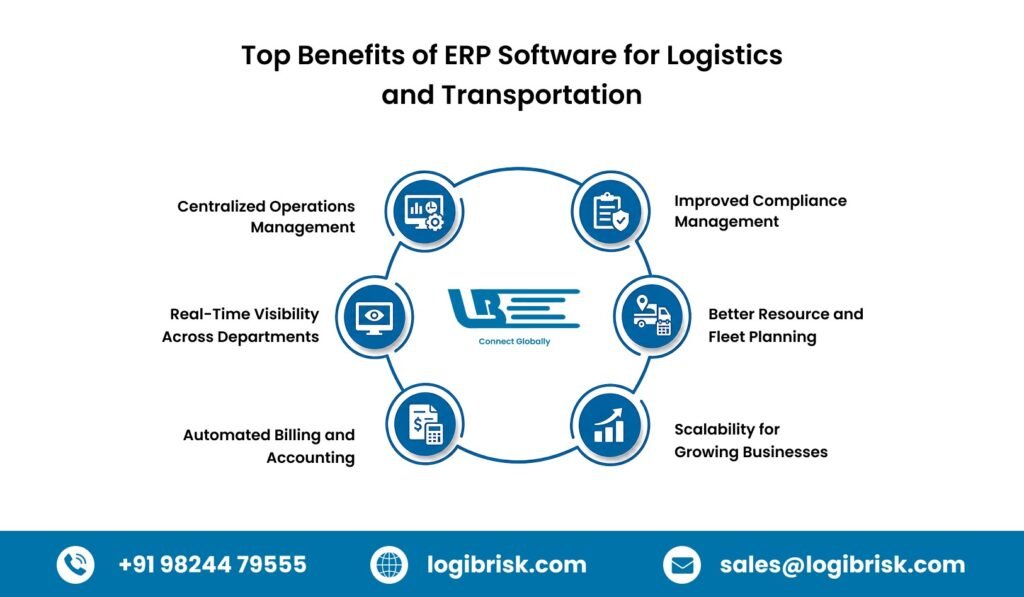
Centralized Operations Management
Instead of a fleet tracking tool, a separate billing system, and an Excel sheet for client management, everything runs from one platform. A 3PL company managing five clients with five different rate cards, for example, can run dispatch, billing, and reporting for every client from the same dashboard, without needing a single spreadsheet to reconcile data between systems.
Real-Time Visibility Across Departments
Operations, finance, and customer service teams all look at the same live data. When a delivery is delayed, the finance team immediately sees the billing impact, and customer service can proactively update the client without requiring three separate phone calls between departments to determine what happened.
Automated Billing and Accounting
Invoices generate automatically from confirmed deliveries, with correct GST rates and HSN codes applied without manual lookup. For a transport company raising hundreds of invoices a month, this alone eliminates the most common source of billing disputes and delayed payments.
Improved Compliance Management
E-Way Bills, GST filings, and audit-ready records are maintained automatically as part of normal operations, not as a separate compliance task someone has to remember to do at the end of each week.
Better Resource and Fleet Planning
Vehicle availability, driver schedules, maintenance status, and route data all live in the same system that handles dispatch and billing. An e-commerce logistics provider managing seasonal volume spikes, such as Diwali and Big Billion Days, can see exactly which vehicles are available and reallocate resources instantly, instead of discovering capacity gaps only after deliveries start failing.
Scalability for Growing Businesses
Adding a new service line, a new client, or a new city of operations means configuring a new module within the existing system, not buying, learning, and integrating an entirely new tool. A fleet owner growing from 20 to 100 vehicles does not need to rebuild their operational stack at every growth milestone.
Key Features to Look for in Logistics ERP Software
Not every ERP labelled “for logistics” actually covers what a transport business needs. Here is what should be included:
- Fleet Management: Vehicle tracking, maintenance scheduling, and utilisation monitoring should be built in, not bolted on as a separate module.
- GPS Tracking: Live location data for every vehicle, integrated directly with dispatch and customer notifications.
- Route Optimization: A built-in route optimization software module that uses AI-driven routing to reduce fuel costs and improve delivery times, connected to real-time traffic data.
- Billing and Accounting: Automated invoice generation, GST-compliant billing, and direct sync with your existing accounting system.
- GST and E-Way Bill: Compliance should be automatic, generated as part of the dispatch process, not a separate portal login.
- CRM: Customer and client details, communications log, and service level details should all reside on the same operational platform.
- Reports and Analytics: Real-time dashboards for fleet performance, billing status, and operational KPIs without manually compiling data from multiple sources.
- Mobile App and Integrations: A driver-facing mobile app, plus the ability to connect with marketplaces, accounting tools, and other systems your business already uses.
How to Choose the Right ERP Software for Logistics Companies
Business requirements: When choosing an ERP for logistics companies, focus on a solution that supports your daily operations, business size, and future scalability.
Scalability: The system should support growth without requiring a platform change every time you add vehicles, clients, or service lines.
Ease of implementation: A six-month implementation project defeats the purpose. Look for providers who can have you operational within days, not quarters.
Integration capabilities: The ERP should connect with your existing accounting software, marketplaces, and GPS hardware, not require you to replace everything at once.
Customer support: Logistics operations run beyond office hours. Support availability should match that reality.
Pricing: Evaluate total cost against the operational inefficiency it replaces, not just the subscription fee in isolation.
Business Impact of ERP Software: ROI for Logistics Companies
The return on ERP investment shows up in three measurable areas:
Cost savings
Automation reduces paperwork and manual coordination across dispatch, billing, and compliance, directly cutting the labour hours spent reconciling data between disconnected systems. Companies running ERP report 20 to 30 percent reductions in operational overhead within the first year, primarily from eliminated manual reconciliation and reduced billing errors.
Time savings
Invoices that previously took days to generate after delivery now trigger automatically. Compliance documentation that took hours to compile manually is continuously filing-ready. The cumulative time saved across a year is substantial, and it is time your team redirects toward growth rather than administration.
Revenue impact
Better fleet utilisation means more deliveries with the same number of vehicles, while faster billing improves cash flow. Integrated express cargo management software helps reduce delays, minimise disputes, and streamline operations. Together, these improvements create a strong financial case for ERP adoption.
3PL providers
A 3PL managing multiple clients with different rate cards and reporting requirements typically spends significant manual hours each month reconciling billing across clients. With ERP, each client’s data, rate card, and reporting runs separately within the same system, eliminating that reconciliation work.
e-commerce logistics
During peak season, order volumes can double or triple overnight. Without ERP, this means scrambling to coordinate fleet, billing, and customer communication manually under pressure. With ERP, the same system that handles normal volume scales automatically, no additional headcount is required to manage the spike.
How ERP Software Improves Logistics and Transportation Operations
The practical impact shows up in the daily workflow. A shipment is booked. The ERP assigns the vehicle and driver based on real-time availability. The route is optimised automatically. GPS tracking begins. The delivery is confirmed digitally. The invoice generates immediately, with correct GST and E-Way Bill data already attached. The client’s account updates. The compliance record is stored.
What previously required five separate manual steps across three different tools now happens as one continuous, automated flow. Your team spends time managing exceptions, such as a delayed delivery or a client query, rather than manually pushing data between disconnected systems.
Who Needs ERP Software in Logistics?
ERP delivers the clearest value for:
- 3PL logistics providers: managing multiple clients with different billing structures and service requirements, where manual reconciliation across clients becomes genuinely unmanageable past a certain scale.
- Fleet owners: who need fleet, billing, and compliance connected as their vehicle count grows beyond what spreadsheets can handle.
- E-commerce logistics: dealing with seasonal volume spikes, multi-channel order flow, and the need for real-time coordination across dispatch, delivery, and customer communication.
- Express cargo and last-mile delivery: Integrated ERP software enables faster dispatch, real-time shipment tracking, and accurate billing for both express cargo and Last Mile Delivery Management Software.
- Growing transport businesses: scaling from a handful of vehicles to a full fleet, where the operational complexity of disconnected tools becomes the single biggest obstacle to further growth.
ERP vs Standalone Logistics Tools
| Factor | Standalone Tools | ERP Software |
| Data flow | Manual disconnected systems | Automatic fully integrated |
| Visibility | Department-wise only | Company-wide, real-time |
| Billing | Separate reconciliation required | Auto-synced with operations |
| Scalability | A new tool is needed for each function | New module within the same system |
| Compliance | Scattered across multiple systems | Centralised and automated |
| Decision-making | Based on delayed, fragmented data | Based on live, connected data |
Why Logibrisk is the Right ERP for Logistics Companies
Logibrisk is an end-to-end ERP for logistics companies, built specifically for Indian transport and logistics businesses. It brings fleet management, billing and accounting, GST and E-Way Bill compliance, CRM, and analytics together in one connected platform.
Instead of managing dispatch, GPS tracking, billing, compliance, and customer data across multiple tools, Logibrisk centralizes operations in a single dashboard. From vehicle assignment and route planning to invoice generation and compliance management, every process stays connected to improve efficiency and visibility.
Trusted by 500+ enterprises and supporting 1 Billion+ shipments, Logibrisk serves businesses across FTL, PTL, express cargo, last-mile delivery, e-commerce logistics, and 3PL operations. Its modular platform also includes auction management software, allowing businesses to streamline freight procurement and vendor management within the same ERP system.
Implementation is fast and hassle-free, with onboarding completed in as little as 5 working days. The Logibrisk team manages setup, integration, and user training, helping businesses transition to a connected logistics ERP with minimal disruption.
Conclusion
Logistics companies still running on disconnected tools are losing time, money, and visibility every single day. The losses are not always visible on a single invoice or a single missed delivery they show up gradually, in reconciliation hours, in billing disputes, in compliance risk, and in the operational ceiling that disconnected systems eventually impose on growth.
ERP software removes that ceiling. It does not just digitise what your team already does manually; a properly configured ERP system that logistics companies rely on connects every part of the operation so that data flows automatically instead of being re-entered, re-checked, and reconciled by hand.
Logistics companies still running on disconnected tools are losing time, money, and visibility every single day. Book a Free Demo with Logibrisk and see how an integrated ERP transforms your operations from day one.
Frequently Asked Questions
Q1: What is ERP software for logistics and transportation?
ERP software for logistics is a centralized platform that integrates fleet management, billing, accounting, compliance, and customer management into one system, improving operational efficiency and visibility.
Q2: How is ERP different from a TMS?
A Transportation Management System (TMS) focuses on dispatch, routing, and fleet operations. ERP includes TMS but also handles billing, accounting, compliance, CRM, and reporting of the business in a single solution.
Q3: Can small logistics businesses use ERP software?
Yes. Cloud-based ERP software is suitable for businesses of all sizes. Even small logistics companies can improve efficiency, automate processes, and scale operations as they grow.
Q4: Does ERP software help with GST compliance?
Yes. Logistics ERP software can automate GST calculations, E-Way Bill generation, invoice management, and compliance reporting, reducing manual work and minimizing errors.
Q5: How quickly can I implement ERP software for my logistics business?
Implementation depends on the solution and business requirements. With Logibrisk, most businesses can complete onboarding and start using the platform within 5 working days.