E-commerce Management
10+ Best E-commerce Management Software in India (2026)





When you sell products online, you have to keep an eye on new orders, items in stock, and parcels going out for delivery. Doing all this by hand takes a lot of time, and small mistakes can lead to missed orders and unhappy buyers.
E-commerce management software puts your orders, stock, and shipping in one place, so you can handle them faster and with fewer mistakes. In this guide, we compare the 10+ best e-commerce management software in India for 2026. You will see what each tool does and which one suits your shop.
Key Takeaways
E-commerce management software is a computer program that brings your online store orders, stock levels, and customer details into one place. When a buyer places an order, it lowers your stock count so you don't sell the same item twice, then sends a packing list to your warehouse team. After the parcel ships, it sends tracking details to the buyer.
Small home businesses and big brands both use it. It is also called an e-commerce management system or an e-commerce management platform.
A note before the list: LogiBrisk is our own product, so we list it first. The other 14 tools follow in no particular order. Features and prices change often, so check each company's website before you decide.
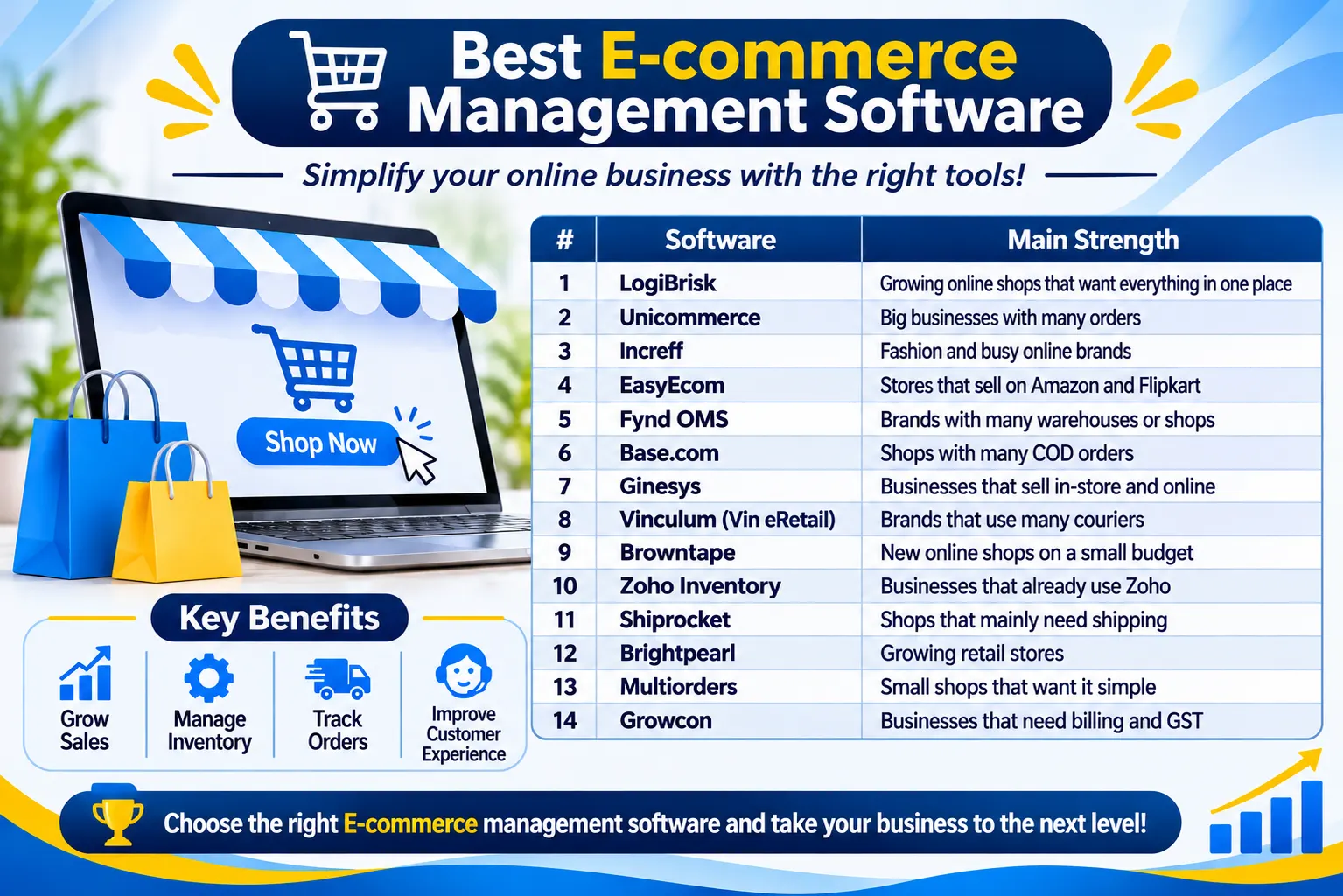
LogiBrisk is an ecommerce management software that puts all your website and marketplace orders on one screen, so no order gets missed.
Packing lists are ready for your warehouse team
Stock updates on every channel, so you don't sell items you don't have
Buyers get order status updates automatically
You can see cost and profit for each order and product
Best for: Growing shops that want orders, stock, and shipping in one place.
Keep in mind: Book a free demo to check that it covers the marketplaces you sell on.
Manages orders, stock, and returns from many websites and marketplaces at once.
Best for: Big brands with a very large number of daily orders.
Keep in mind: It may be more than a very small shop needs.
Helps you manage online orders and your warehouse together.
Best for: Brands that sell a lot on their own website and on marketplaces.
Keep in mind: Very small shops may find it bigger than they need.
Keeps your stock and orders matched across all your marketplaces.
Best for: Stores that sell mostly on Amazon, Flipkart and similar sites.
Keep in mind: Check that it connects with every marketplace you use.
Chooses the best warehouse or shop to send each order from, so orders reach buyers faster.
Best for: Brands that ship from more than one place.
Keep in mind: With one warehouse, you may not need it.
Syncs stock and orders across your channels, with a focus on Indian needs like cash on delivery (COD) and GST.
Best for: Shops that get many COD orders.
Keep in mind: Check that its list of marketplaces covers the ones you sell on.
Handles billing, stock, and orders for both your shop and your online store. You can add only the parts you need, like billing (POS) or GST tools.
Best for: Businesses that sell in a store and online.
Keep in mind: If you sell only online, you may need fewer of its features.
Connects your store with many marketplaces, couriers, and warehouses.
Best for: Brands that use many couriers and sales channels.
Keep in mind: Ask how long setup takes.
Helps you manage orders, stock, and product listings on many marketplaces.
Best for: New and small online shops that want an affordable tool.
Keep in mind: Check that it can grow with you as your orders increase.
Tracks stock, orders, and shipping, and works with other Zoho apps like accounting.
Best for: Small businesses that already use Zoho.
Keep in mind: Check that it connects with the marketplaces you need.
Lets you print labels, book pickups, and track orders in one place.
Best for: Shops that mainly need simple, fast shipping.
Keep in mind: Think about how much order and stock control you need beyond shipping.
Manages orders, stock, and accounts together.
Best for: Growing retailers that need advanced tools.
Keep in mind: Check that it supports India needs like GST and COD.
Brings orders, stock, and shipping into one place with simple automation.
Best for: Small shops that want easy setup.
Keep in mind: Fast-growing shops may outgrow it.
Helps you manage orders, billing, and accounts, with strong GST support.
Best for: Small businesses and distributors that need billing help.
Keep in mind: For advanced order tools, you may need extra add-ons.
Follow these five easy steps to find the best e-commerce management platform for your shop.
Count your daily orders: About 10 orders a day? A simple tool is enough. About 1,000? Choose a stronger e-commerce management system. Don't pay for features you won't use.
List where you sell: Write down your website and every marketplace, like Amazon and Flipkart. Then check that the software connects with all of them.
Check shipping support: Choose ecommerce delivery management software that prints labels, books pickups, and sends tracking links to your buyers. Good ecommerce logistics software handles all of this in one place, which makes ecommerce logistics management much easier.
Check COD and GST support: Most Indian online shops need both. Pick a tool that also connects with your billing and accounts management system, so your tax numbers stay correct.
Try a free demo: Test the software with your own orders for a week, and see if your team finds it easy to use.
Tip: Once you start, turn on automatic stock updates from day one, and show your team how to use the packing lists.
Good e-commerce management software helps your store pack parcels faster and keep buyers happy. When your orders, stock, and courier labels share information in one place, your team stays calm even during big festive sales. A good ecommerce delivery management system also keeps tracking in sync with your orders.
Pick two or three tools that match your shop and test them with your own orders. If you want orders, stock, and shipping on one screen, try LogiBrisk and book a free demo.
It depends on your shop. LogiBrisk suits growing shops that want orders, stock, and shipping in one place. Unicommerce and Increff suit big brands. EasyEcom suits stores that sell on marketplaces, and Base.com suits shops with many COD orders. Try a demo with your own orders before you choose.
Yes, once orders come from more than one place. Good ecommerce software helps a small shop sending ten parcels a day print labels quickly and save hours of typing customer addresses by hand.
It updates your stock on all your online stores the moment a customer buys. An item that sells out is marked out of stock everywhere, so no other buyer can order it.
It connects your store with shipping companies. When an order arrives, it creates the label, books a pickup, and sends tracking links to your buyer.
The price depends on how many orders you ship and which features you need. Many tools charge a monthly or yearly subscription. Ask each company for a quote or demo to get exact pricing.