Auction Software
7 Steps to Choose the Right Auction Management Software
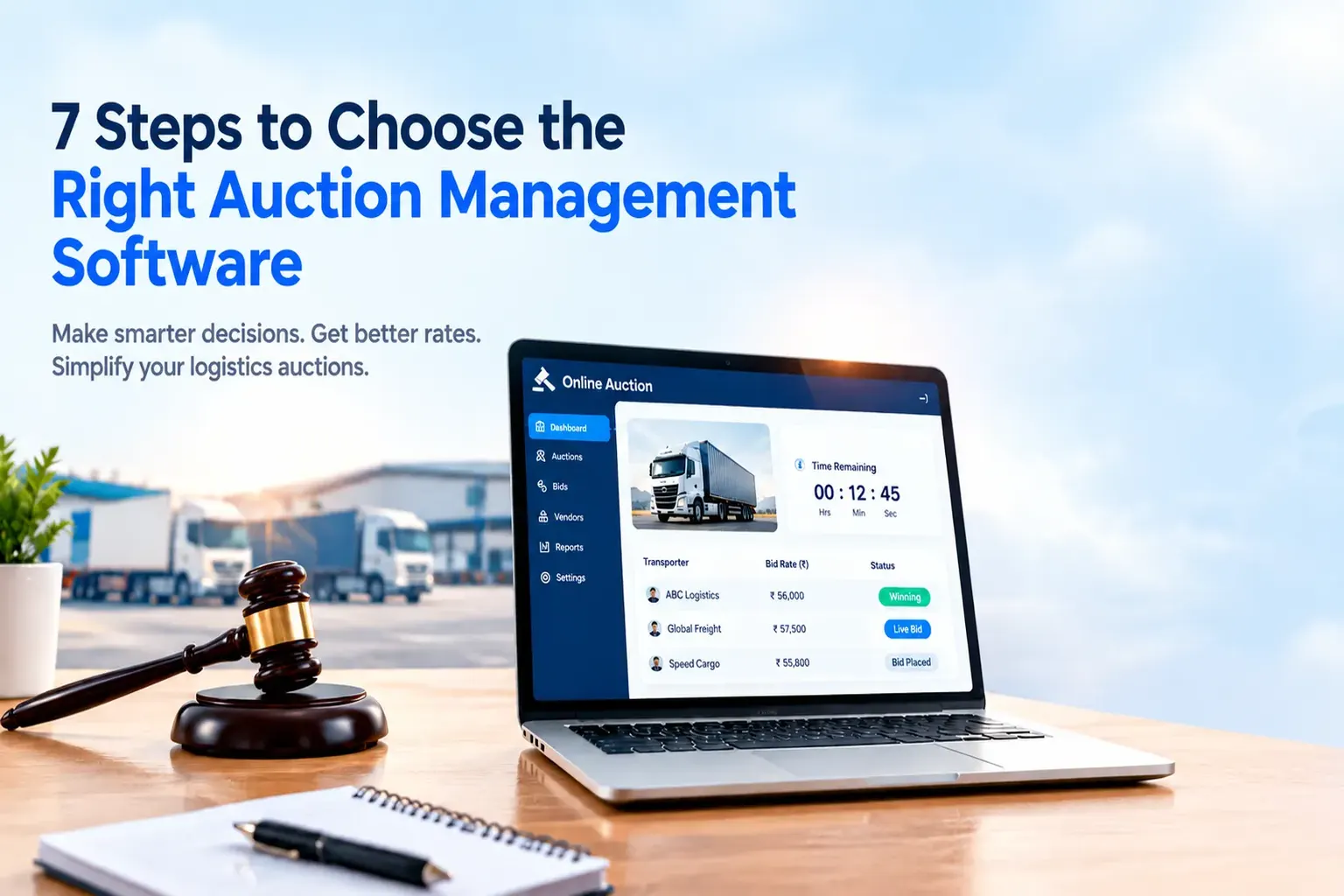
You have a load going to Nashik. You call the vendor you always call. He says ₹18,000. You push a little, he comes down to ₹17,500, and you book it.
You will never find out that two other vendors would have done it for ₹16,200.
That is what happens every time rates are fixed on a phone call. Only the vendors you called get to quote, and only the first number they say becomes the starting point.
Auction management software changes that. Your load goes to every approved vendor at the same time, they bid against each other, and you get the rate the market actually offers. This guide walks through seven steps to pick the right one.
Auction management software runs your freight procurement as a live bidding event instead of a round of phone calls.
You post a lane or a load, your approved vendors see it, and they bid. Rates drop as they compete, and the system records every bid with a timestamp.
In logistics this is almost always a reverse auction. In a normal auction the price goes up as buyers compete. In a reverse auction you are the buyer, vendors compete to serve you, and the price goes down.
Good auction management software handles both the bidding itself and everything around it: vendor lists, rate approvals, award decisions, and the audit trail your finance team will ask for later.
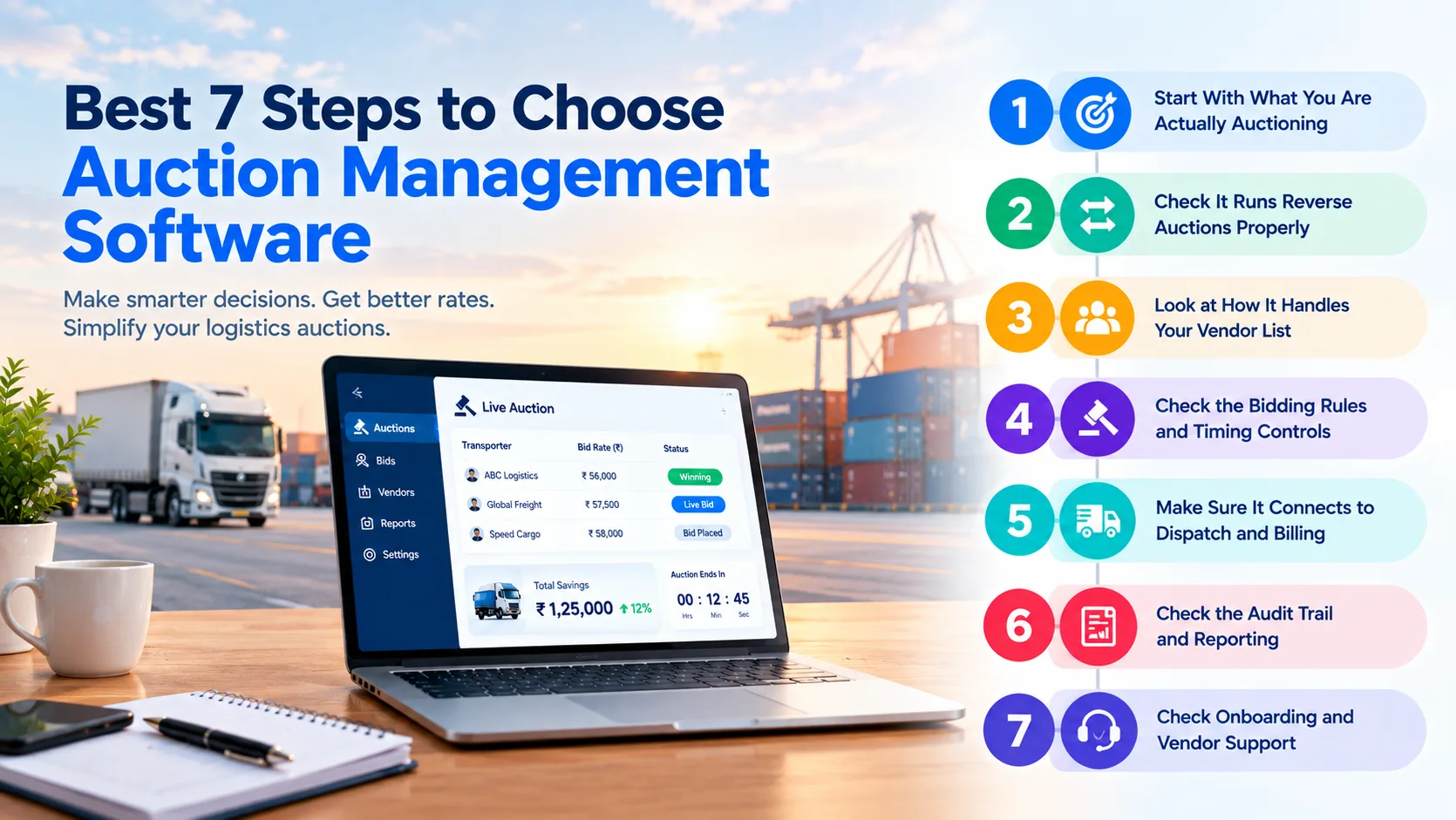
Work through these in order, because each one rules out platforms that will not suit how you buy freight.
Before comparing platforms, be clear about what goes up for bid. The answer changes which features matter.
Most Indian transport businesses auction one of three things:
A platform built only for asset sales will not handle daily spot loads well. One built for spot freight may not manage a six-month lane contract. Know which you need before the first demo.
If you are auctioning old vehicles, pull the resale list from your fleet management software so age, running condition, and service history go out with the listing.
Many auction management solutions are built for normal auctions, where the price goes up, because that is the bigger market. Buying freight needs the opposite.
Ask to see a reverse auction run live. Watch for three things:
Without those three, the bidding drags on and wastes everyone's afternoon.
Your auction is only as good as who is in it. Two vendors bidding is a negotiation. Eight is an auction.
Check whether the platform lets you group vendors by region or lane, so a Gujarat load only goes to vendors who run Gujarat. Check whether you can hold an approved list with documents and performance history attached.
Vendor GST status matters here too. A vendor with a lapsed GSTIN cannot raise a valid invoice, so a GST and E-Way Bill enabled logistics system checking that before the award saves an argument after it.
Also ask how vendors actually join. If a small transporter needs a laptop and a training session to place a bid, he will not bid. Mobile bidding matters more here than most demos suggest.
This is where most buyers stop asking questions, and it is where auctions are won or lost.
The important one is what happens in the last few seconds. If the auction stops dead at the closing time, a vendor can drop his bid in with two seconds left and nobody gets a chance to beat it.
The fix is called the three-minute rule. Any bid in the last three minutes pushes the clock out by three more, so everyone gets a chance to answer. The auction ends when bidding stops, not when the timer does.
Confirm the platform supports it, and confirm you can set the window yourself. Three minutes suits most freight auctions, but a high-value lane may want longer.
An auction that ends in a spreadsheet has solved half the problem. You still have to create the trip, enter the vendor, and type the rate into your billing system by hand.
The right smart auction management system sends the winning rate straight into dispatch and billing. The trip opens with the vendor and rate already on it, and the bill goes against the right party.
This matters most if you already run transportation management software. An auction tool that sits apart from your dispatch system adds a data entry step instead of removing one.
Buying freight raises questions. Why did this vendor win? Why is this lane costing more than last quarter? Did anyone see the other bids before placing theirs?
Proper auction tracking software answers all three without anyone reconstructing the story from memory. Every bid is timestamped, every award is logged with who approved it, and the full history stays retrievable.
Where it connects to smart accounting management software, that winning rate also lands in your books, so the rate you agreed and the amount you pay never differ. The same idea runs the other way on your own invoices, which our guide to GST billing software covers in detail.
Beyond the audit trail, look for reporting that tells you something useful. An auction tracking system should show your rate trend per lane over time, savings against your ceiling price, vendor participation rates, and who wins most often. That last number is worth watching, because one vendor winning everything usually means the others have stopped trying.
Auction software has a problem most logistics tools do not. You are not the only one who has to learn it. Every vendor does too.
Ask who sets your vendors up. If the answer is you, plan for it, because a platform with eight vendors signed up and two who actually bid saves you nothing.
Ask how long setup takes, and what happens when a vendor cannot log in at 9 PM with a load closing at 10. Support hours matter more here than with most software, because auctions run to a clock.
Consider a transporter in Gujarat moving 40 contract lanes, currently fixed by phone every quarter.
Whoever fixes the rates calls four regular vendors per lane. It takes most of a week, and the rates land wherever the first quote started.
With online auction management software, all 40 lanes go out to 15 approved vendors over two days. Vendors who never got a call now bid, and the vendor who already runs the lane has to defend his rate instead of repeating it.
The saving is not only on price. Your team gets that week back, and accounts gets a proper bid record instead of a note on a phone.
The value is clearest for these operations:
Logibrisk runs freight auctions inside the same platform that handles your dispatch, fleet, and billing.
The winning rate flows straight into the trip and into smart billing management software, so what you owe the vendor matches what he actually bid, with nothing typed twice.
Vendors bid from their phone, you set how long the closing window stays open, and every bid stays on record. Trusted by 500+ enterprises across FTL, PTL, express cargo, last-mile, and 3PL operations.
Setup takes 5 working days, and that includes getting your vendors bidding, not just your own team trained.
Freight rates are the biggest cost most transport businesses never really test. You argue them down a little, but you never find out what you would have paid if everyone had quoted at once.
Auction management software answers that on every load. The rate you pay becomes the rate the market set, not the number one vendor happened to start with.
If buying freight is one of several places your spreadsheets are struggling, ERP software for logistics covers what changes when bidding, dispatch, and billing all run from one system.
See what your lanes are really worth. Book a Free Demo with Logibrisk and run your next load as an auction.
The best auction management software depends on what you are auctioning. For freight, look for reverse auctions, bidding from a phone, a closing window you can set, and a direct link to your dispatch and billing system.
If a bid arrives in the final three minutes, the closing time moves out by another three minutes. It stops a vendor winning with a last-second bid nobody could answer, so the auction ends when bidding stops rather than when the clock does.
You post a lane or load and vendors bid to carry it, with the price moving down instead of up. The lowest bid that meets your terms wins, which is how transport businesses use auctions to hire trucks.
Yes. If you hire even five or six vendors regularly, running those rates through an auction usually beats phone negotiation, because all your vendors quote against each other on the same day.
Most Logibrisk customers go live within 5 working days, vendors included. Getting your vendors actually bidding is what decides whether the platform works, so it is handled as part of setup.