E-commerce Management
E-commerce Management Software: A Simple Guide
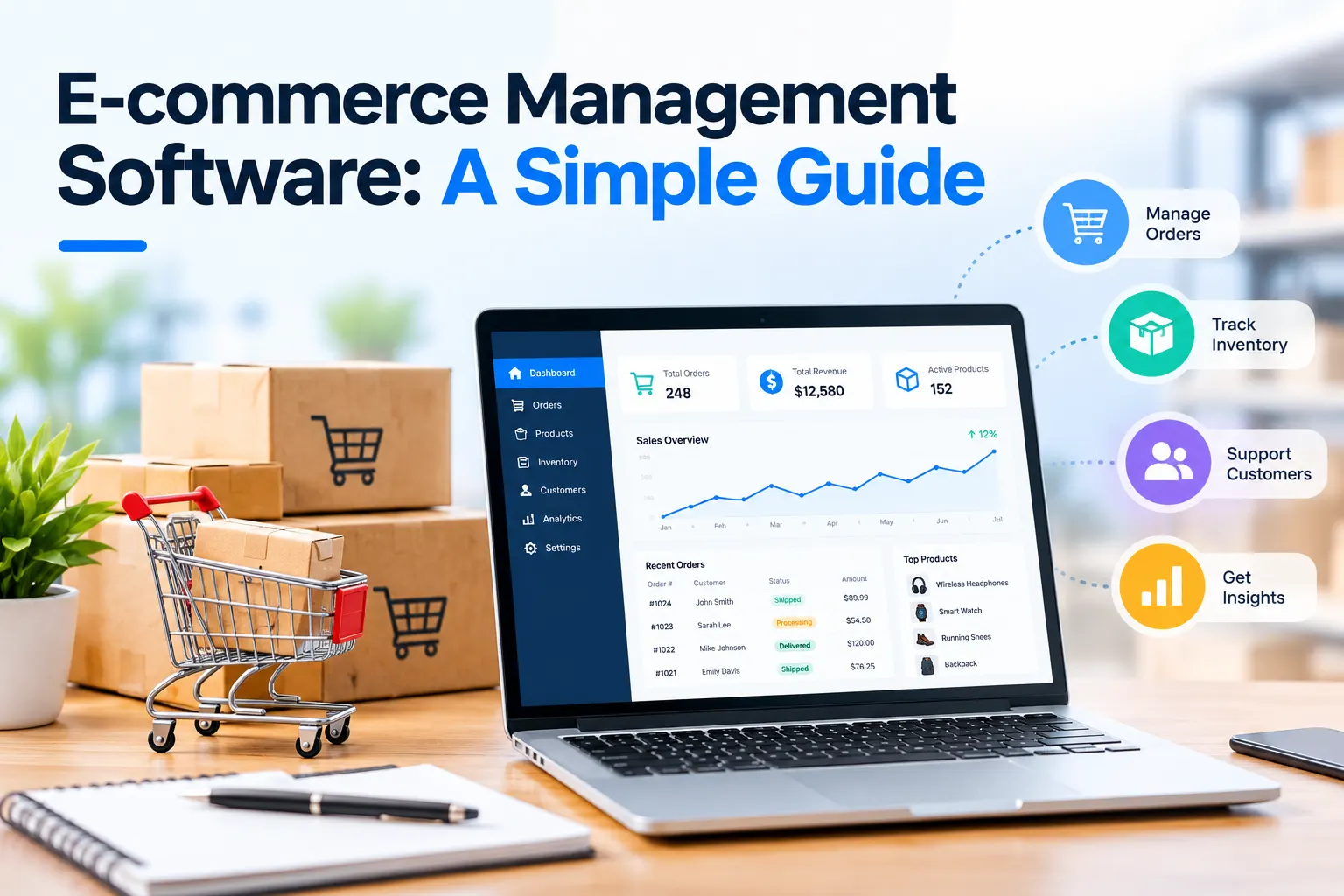
Selling online is the easy part. Getting every order packed, shipped, and paid for is where the work is.
The best ecommerce management software in India helps handle that work for you. It collects your orders, tracks your stock, helps you choose the right courier, and follows the payment until it reaches your account.
This guide covers what ecommerce management software does, the four types available, and how to choose the right one for your business.
E-commerce management software handles everything that happens after a customer clicks buy.
Orders arrive from your website and your marketplace accounts. From there the software:
It is not the same as your store platform. Shopify, WooCommerce, and Magento display products and take payments. The best ecommerce management software helps handle what happens after an order is placed, including fulfilment, shipping, and order tracking.
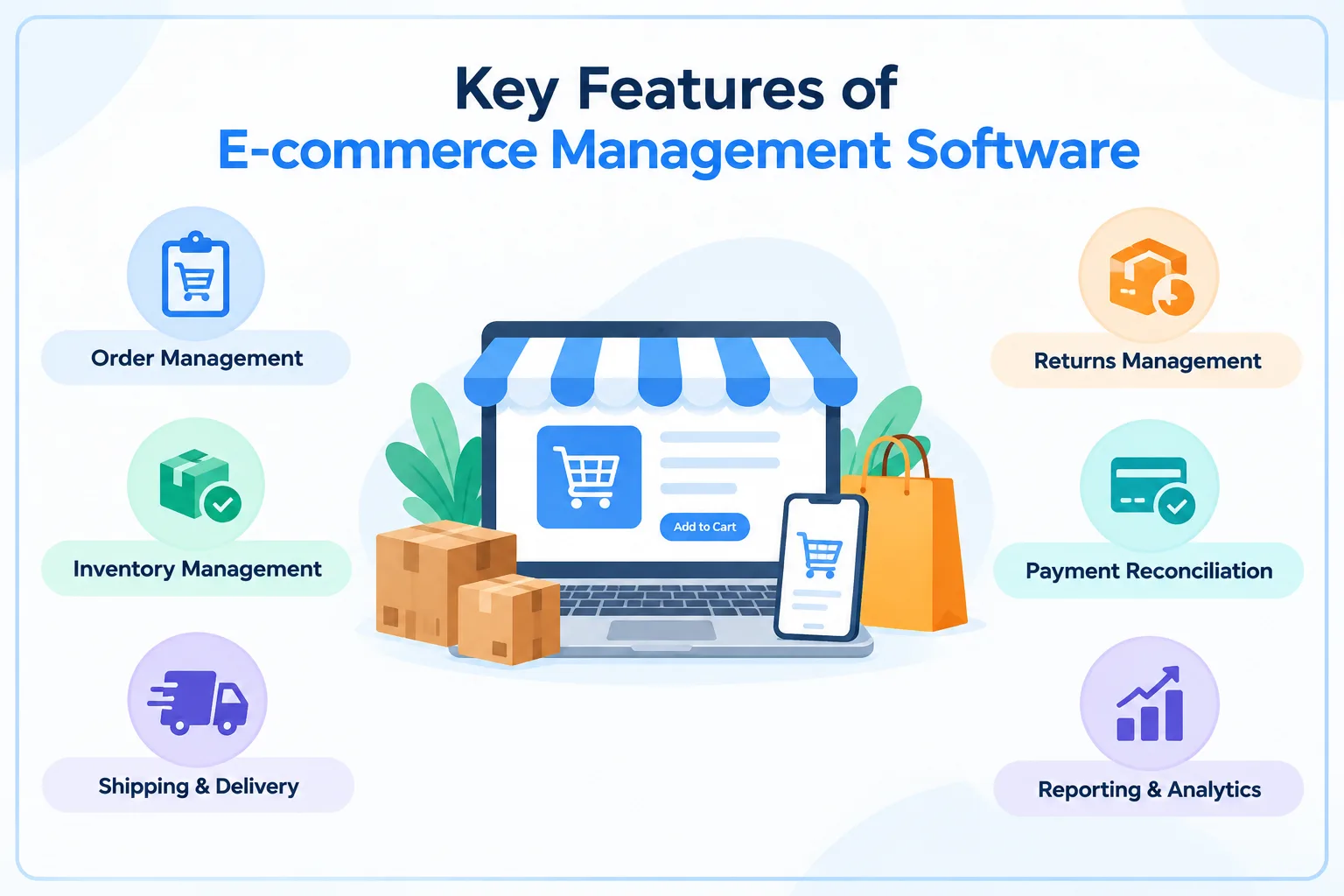
Six features cover almost everything a growing seller needs from e-commerce management software.
Every order from every channel lands in one list. Your own website, Amazon, Flipkart, Meesho and anywhere else you sell.
Your team stops logging into separate seller panels each morning to see what came in overnight.
When a product sells on one channel, the count drops everywhere else.
Without this you oversell. The customer orders something you do not have, you cancel, and your marketplace rating takes the hit.
Good ecommerce delivery management software selects the courier for each order, prints labels in bulk, and tracks parcels from one screen.
It should choose by pincode performance, weight and cost rather than by whichever courier your team always uses. That is the part most sellers mean when they say ecommerce delivery management.
Returns are where margin disappears in Indian e-commerce, and most sellers plan for them last.
The system should schedule the pickup, record the quality check, and trigger the refund without anyone chasing it by email. Our guide on choosing ecommerce delivery software covers the four stages where an order loses you money.
Cash on delivery money comes back from couriers in lump sums. Marketplace payouts arrive after their own deductions.
Both need tying back to the orders behind them. Few sellers do it properly, which is why money goes missing quietly rather than loudly.
Which products sell, which couriers deliver on time, which pincodes return most, and what each order earned after shipping and returns.
Almost every seller knows the monthly revenue figure. Far fewer know what a single order earned.
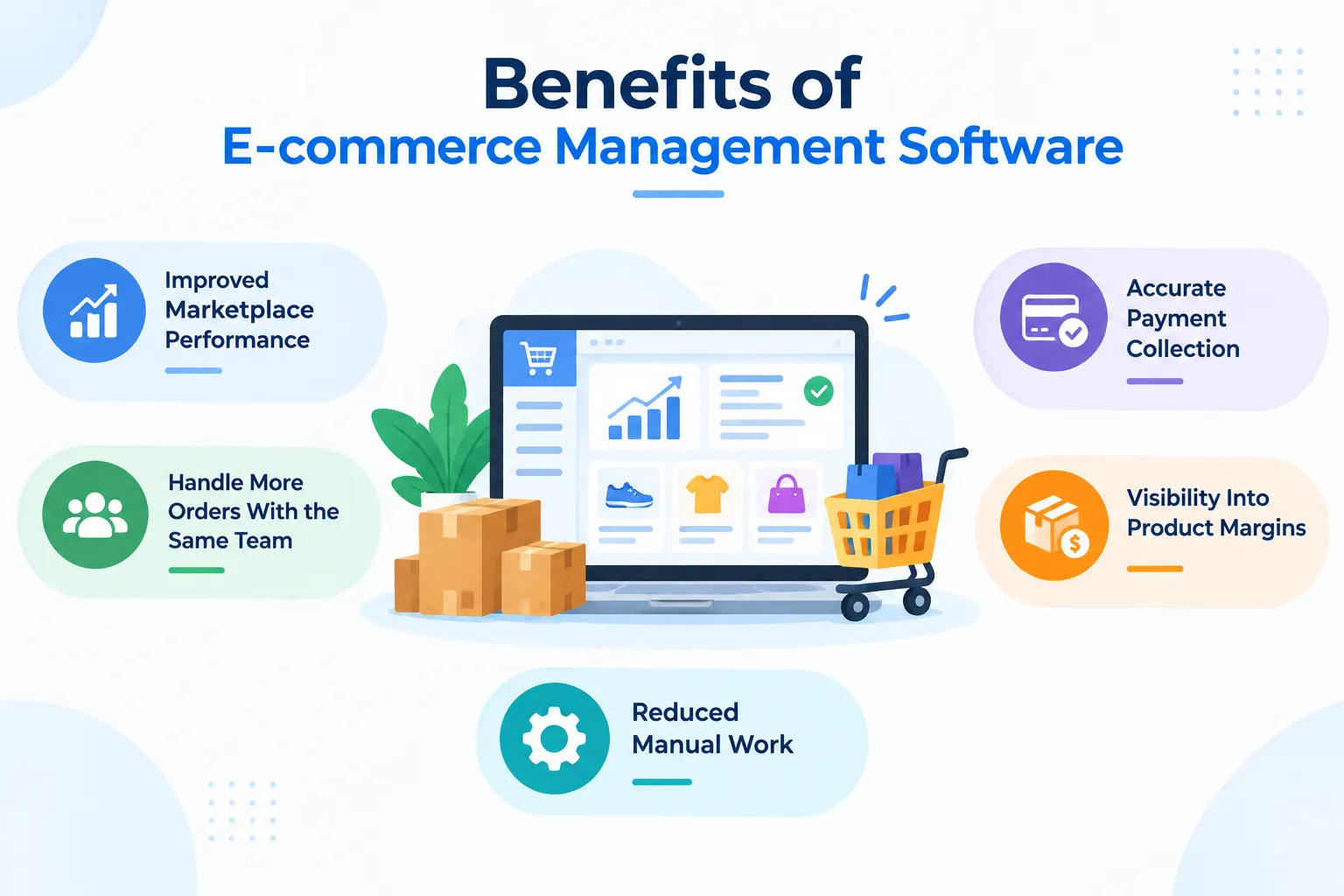
The features above are what e-commerce management software does. These are what changes in the business as a result.
Overselling leads to cancellations, and cancellations drag down a seller rating. That rating decides how often a listing appears in search.
One bad week can cost weeks of visibility. Accurate stock across channels protects the traffic already paid for.
Most sellers hesitate before launching on a new marketplace. It means another panel to check and another set of orders to process by hand.
Once every channel feeds one system, the third marketplace costs nothing in headcount.
Money that comes late or short cannot be spent on stock. Matching each payout to the orders behind it brings shortfalls to light the same week instead of at year end, especially when it feeds straight into your billing and accounts system.
For a seasonal business, that difference decides whether inventory gets bought before a festival or after it.
Plenty of products look profitable until shipping and returns are counted against them.
Profit per order shows which ones deserve a reorder and which quietly drain margin. That is a buying decision, not a software one.
Copying order data between panels produces nothing. Neither does calling a courier for a tracking update.
Remove both and the same team spends its mornings on sourcing, listings and customers.
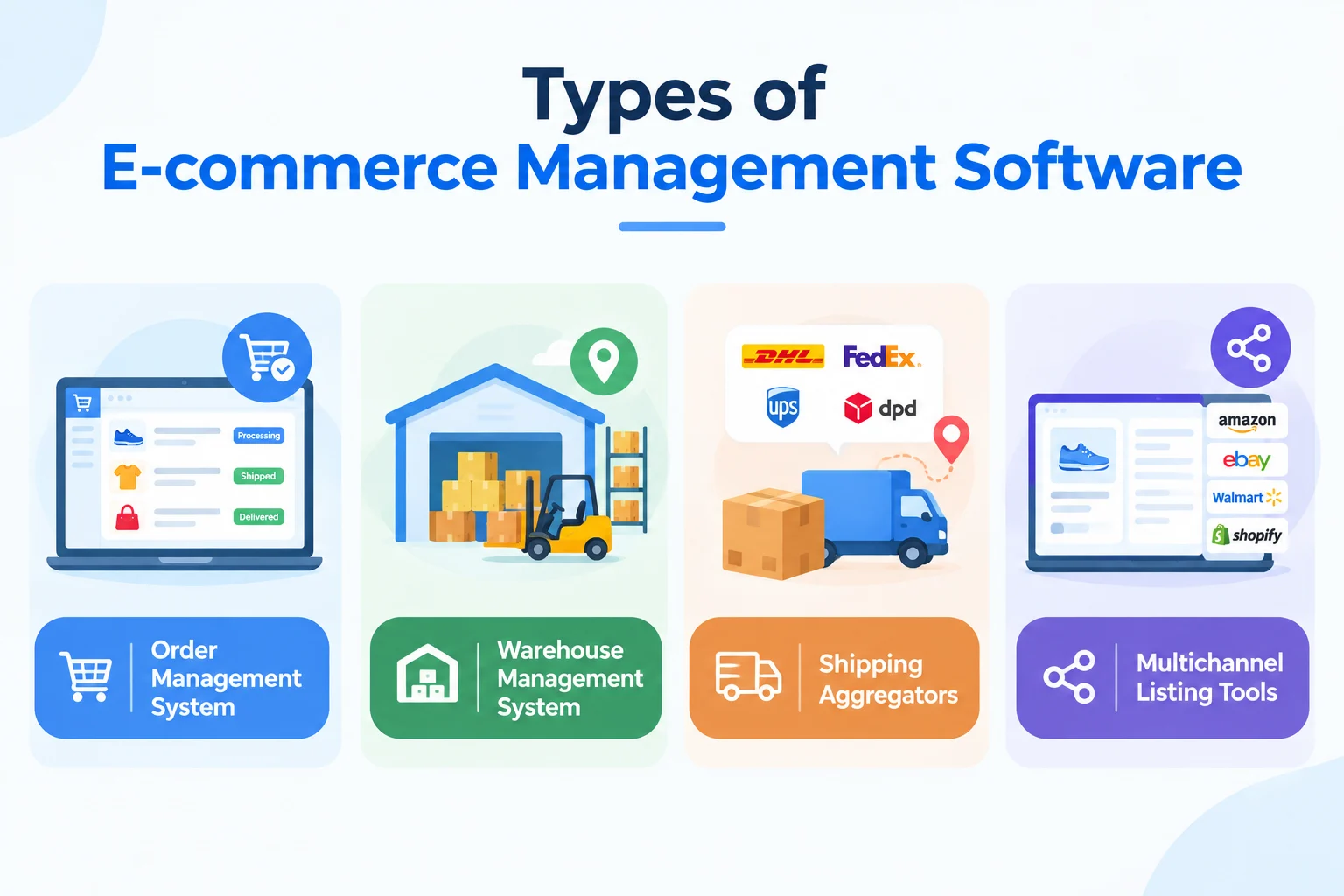
E-commerce management software is not one product. Picking the wrong type is the most expensive mistake in this market, because you end up paying for a tool that solves a problem you do not have.
Four categories cover almost everything sold in India. Some vendors bundle all four into a single ecommerce logistics and shipping software solution, which is worth asking about if you would rather deal with one supplier.
|
Type |
Handles |
Does Not Handle |
Choose It If |
|
Order Management System (OMS) |
Brings orders from all your channels into one list |
Does not pack the box or pick the courier |
You check three seller panels every morning |
|
Warehouse Management System (WMS) |
Runs the work inside your warehouse: where stock sits, picking and packing |
Does nothing once the box leaves your door |
Your stock count never matches the shelf |
|
Shipping aggregator |
Picks the courier, prints labels, tracks parcels, handles COD money |
Does not track your stock |
Shipping is your biggest daily headache |
|
Multichannel listing tool |
Keeps your listings, prices and stock the same everywhere you sell |
Does almost nothing after someone places an order |
You sold something you did not have |
A best order management system helps manage an order from the moment it arrives to the moment it is delivered. It pulls orders from every channel, routes them, tracks dispatch, and manages returns.
This suits sellers on two or more channels who keep losing track of which order came from where. Order management software for eCommerce businesses helps bring these orders together and makes them easier to manage. What it will not do is run the warehouse floor, so a seller holding large stock usually needs something alongside it.
A good warehouse management system helps manage the work inside your warehouse, including putaway, bin locations, picking, packing, and stock counts.
The difference between the two is simple. An OMS manages what needs fulfilling. A WMS manages how it gets done on the floor.
Sellers holding their own stock across one or more warehouses need this. It stops at the warehouse door, though, so it will not pick a courier or chase a failed delivery. For the leg between warehouses, that is a job for transportation management software.
A good shipping aggregator connects you with multiple courier partners and helps manage courier selection, label printing, tracking, failed deliveries, and COD remittance.
Most Indian sellers start here because shipping is usually the first thing that breaks. This is ecommerce logistics software rather than order management, so it is light on inventory and most sellers add something upstream as they grow.
A good multichannel listing tool helps manage product listings, product data, pricing, and stock levels across Amazon, Flipkart, Meesho, and your own store.
They suit marketplace-first sellers with large catalogues to keep in sync. They get the listing right but do very little once an order is actually placed.
If you ship outside India, none of these four handle customs paperwork. Ecommerce clearance software covers shipping bills, commercial invoices and HS codes, and it is usually bought separately.
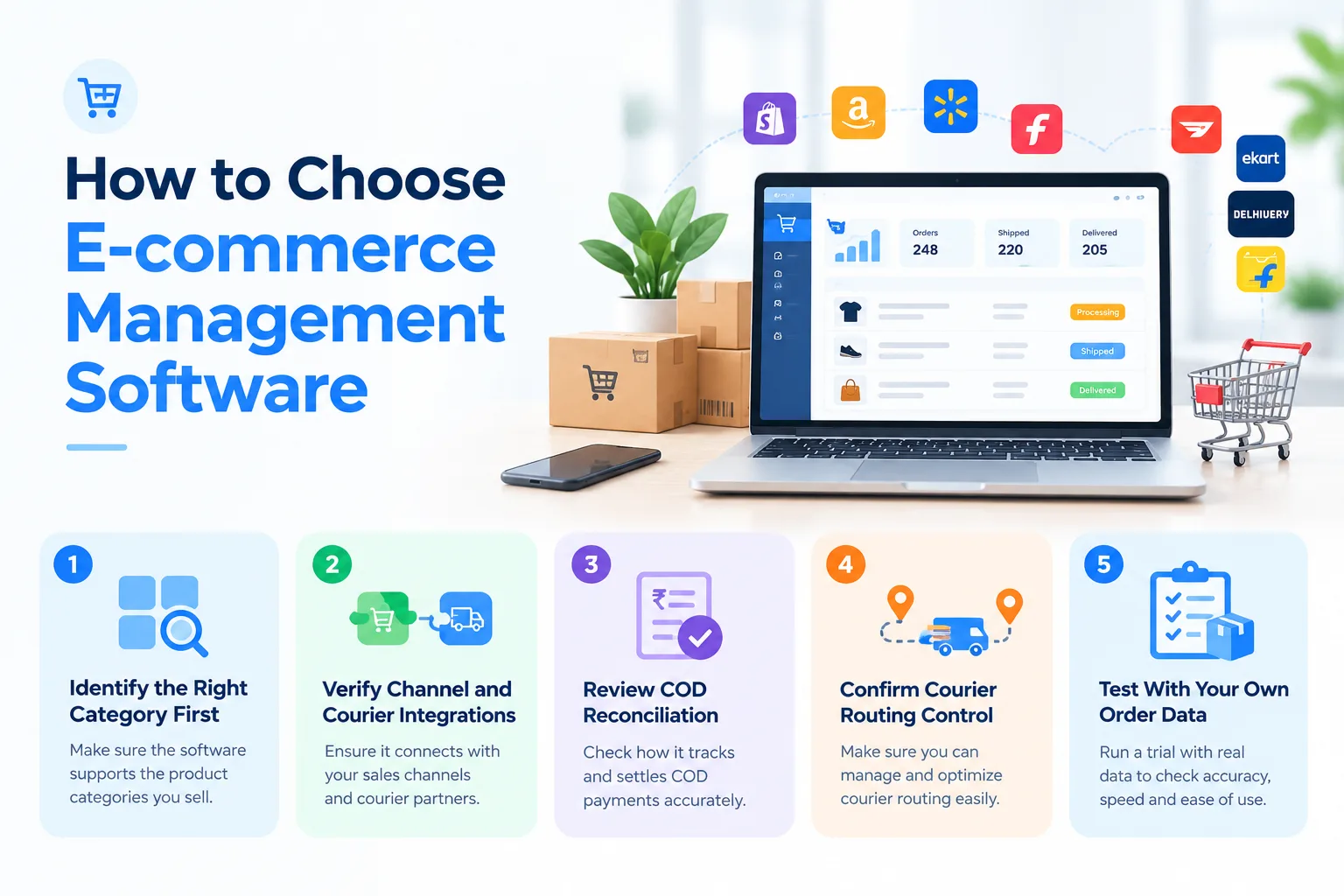
Work through these five checks in order when comparing e-commerce management software. The first one narrows the field before you sit through a single demo.
Decide which of the four categories above matches your problem before you look at any platform. A shipping aggregator and a warehouse system are both good software, and one of them is useless to you.
Skip it and you end up comparing an OMS against a courier tool as if they were alternatives. They are not.
Ask for the named list of channels and couriers it connects to, in writing. A general yes means nothing.
If one channel is missing, that channel stays manual. You will have solved half the problem and paid full price for it.
Ask too whether setup and training are included or sold as ecommerce management software services on top of the licence.
Cash on delivery is still the majority of Indian orders, and it is where money quietly disappears.
Ask to see a courier remittance matched back to the orders behind it. If the answer is that your accountant does that in a spreadsheet afterwards, nothing has changed. A platform that treats COD as a payment type rather than a cash-handling workflow was not built for this market.
Some platforms route orders by their own commercial arrangements rather than yours.
Ask to see the routing screen and confirm you can set your own rules by pincode, weight and cost. If the rules are fixed, you are not choosing couriers, the platform is.
The same question applies to any smart last mile delivery module if you also run your own riders.
Demo data is always clean. Yours will not be.
Take a real week of orders with your actual pincodes and product weights, and watch where the system struggles. Pay attention to the addresses that fail and the returns workflow, because both get skipped in a standard demo.
If a vendor will not run your data, that tells you something before you have signed anything.
E-commerce management software is the e-commerce supply chain software layer that connects your store, your stock, your couriers and your money. Start with whichever part is costing you most today, whether that is overselling, rising returns, or COD payments arriving late.
Once you know the category you need, shortlist two platforms and run a real week of your own orders through each. That single test will tell you more than any feature comparison. If you are looking for ecommerce software management in India, LogiBrisk can help you manage orders, shipping, fleet operations, and other day-to-day processes from one platform.
It is software that handles everything after a customer places an order: collecting orders from every channel, keeping stock counts right, choosing a courier, printing labels, handling returns, and checking the money that comes back.
No. Shopify is a store platform that shows products and takes payment. Courier selection, COD matching and returns need separate e commerce logistics software connected to it.
No, not yet. One channel and one courier can be managed by hand without much trouble. That changes once you add a second channel, or once returns start costing real money and nobody can say which products or pincodes are causing them.
An OMS manages what needs fulfilling. A WMS manages how it gets done on the warehouse floor. The OMS collects orders from every channel and decides where each one is fulfilled from. The WMS runs putaway, picking and packing once it arrives there.
Per order, or a monthly plan based on how much you ship. Shipping-only tools usually cost least and all-in-one platforms most. Check whether channel integrations, setup and out-of-hours support are included or billed on top of the licence.
Yes. The software matches every courier payment against the orders it covers and flags anything short or overdue. Check this before buying, because COD is where Indian sellers lose money quietly.
About two weeks. Connecting your store takes a day or two, and loading courier contracts and routing rules takes the rest. The part that slows most sellers down is deciding the routing rules themselves, which is worth settling before the software arrives.