FTL Logistics
Full Truck Load (FTL) Management Software: A Simple Guide
Running full truck loads looks simple from the outside. One client, one truck, one destination.
The work sits in everything around it. Finding a vehicle at the right rate. Getting the paperwork correct before the truck leaves. Knowing where it is for the next three days, and settling the freight without an argument.
This guide covers what FTL management software does, the features that matter, how full truck load differs from part truck load, and how to choose the right one for an Indian transport business.
Full Truck Load (FTL) Management Software helps transport businesses manage the complete journey of a truckload, from booking a vehicle to final payment. It brings key tasks such as vehicle assignment, trip planning, lorry receipt (LR) generation, E-Way Bill creation, GPS tracking, proof of delivery (POD), customer invoicing, and truck owner payments into one system.
Instead of managing these tasks through separate WhatsApp messages, spreadsheets, government portals, phone calls, and accounting records, businesses can handle them in one place. FTL ERP software may also include additional features such as accounting, payroll, and vehicle maintenance to manage more of the business in a single system.
Six features cover what a full truckload operation needs day to day.
A client sends a load requirement, which the trade calls an indent. The software records it, then tracks whether a vehicle has been arranged against it.
This is the step most operations handle on WhatsApp, which is why nobody can say at 4pm how many of today's indents are still unplaced. A smart full truckload management system puts that board on one screen.
Most Indian transporters run a mix of own trucks and market vehicles hired through brokers and suppliers.
A good platform holds your rate history by route, or lane, and by supplier. That way you know what the Surat to Delhi run cost last month before agreeing a price today. LogiBrisk and a few other Indian platforms also run this through an auction management system, letting suppliers bid rather than you negotiating one by one.
Every trip needs a lorry receipt, and most need an E-Way Bill before the vehicle moves.
Both should come out of the trip record you already created, not be typed again on a separate portal. Good GST and E-Way Bill software also warns you when a bill is close to expiring, because an expired E-Way Bill at a checkpost is an expensive afternoon.
A Surat to Delhi run takes three days. Your client will ask where the truck is at least twice in that time.
Location should come from the GPS already fitted to the vehicle, so your team answers from a screen instead of calling the driver.
The driver uploads the signed POD from his phone at the delivery point.
Paper PODs travelling back to your office by courier are what delay billing by two weeks. A digital one lets the invoice go out the same day.
For every market vehicle you hire, there is an advance paid at loading, a balance due at delivery, and often a detention charge argued over afterwards.
All three belong on the trip record, with a running total of what is still owed to each supplier. Without that, this lives in a diary and the numbers rarely match.
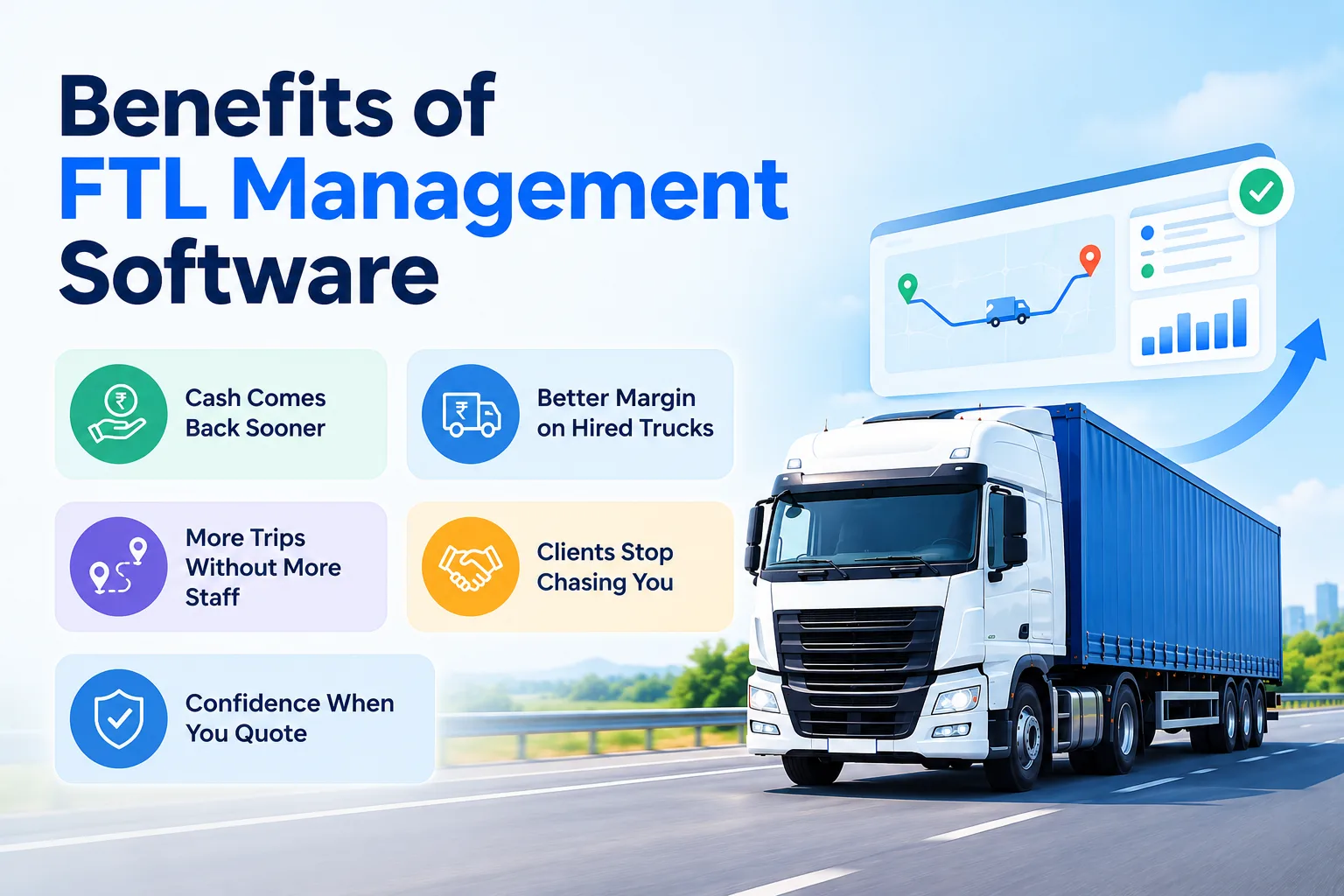
The features above are what the software does. These are what changes in the business.
Invoices raised two weeks earlier means the money for one trip is in the bank before the next one loads.
For a transporter funding advances to truck owners out of pocket, that is the difference between running on your own money and running on a bank line.
Suppliers quote what they think you will accept. When the last six rates on that route are on screen in front of you, the conversation changes.
Over a year on a regular lane, a few hundred rupees a trip is a figure worth protecting.
Growing from thirty trips a week to sixty normally means hiring in the back office.
When indents, documents and billing stop being manual, the same team absorbs the volume and the hiring money goes into vehicles instead.
A client who has to ring twice for an update starts quietly looking for another transporter.
Answering in ten seconds, every time, is the kind of thing that keeps a contract at renewal when a competitor undercuts you by two percent.
Knowing what a route actually earned, after the vehicle, tolls, driver and detention, tells you which business to chase and which to let go.
Most transporters price a new lane on instinct because the old numbers were never in one place.
Before choosing a platform, be clear which kind of load you actually move. The two work differently, and so does the software built for them.
| Full Truck Load (FTL) | Part Truck Load (PTL) | |
|---|---|---|
| What it means | One consignor books the entire vehicle | Several consignors share the same vehicle |
| Who pays | One client pays for the full truck | Each client pays for the space used |
| Route | Point to point, direct | Multiple pickups and drops |
| Transit time | Faster, no stops in between | Slower, depends on the other loads |
| Best for | Loads above eight to ten tonnes | Smaller consignments |
| What you track | One trip, one vehicle, one rate | Many consignments inside one trip |
| Billing | One invoice per trip | One invoice per consignment |
| Software built around | The trip | The consignment |
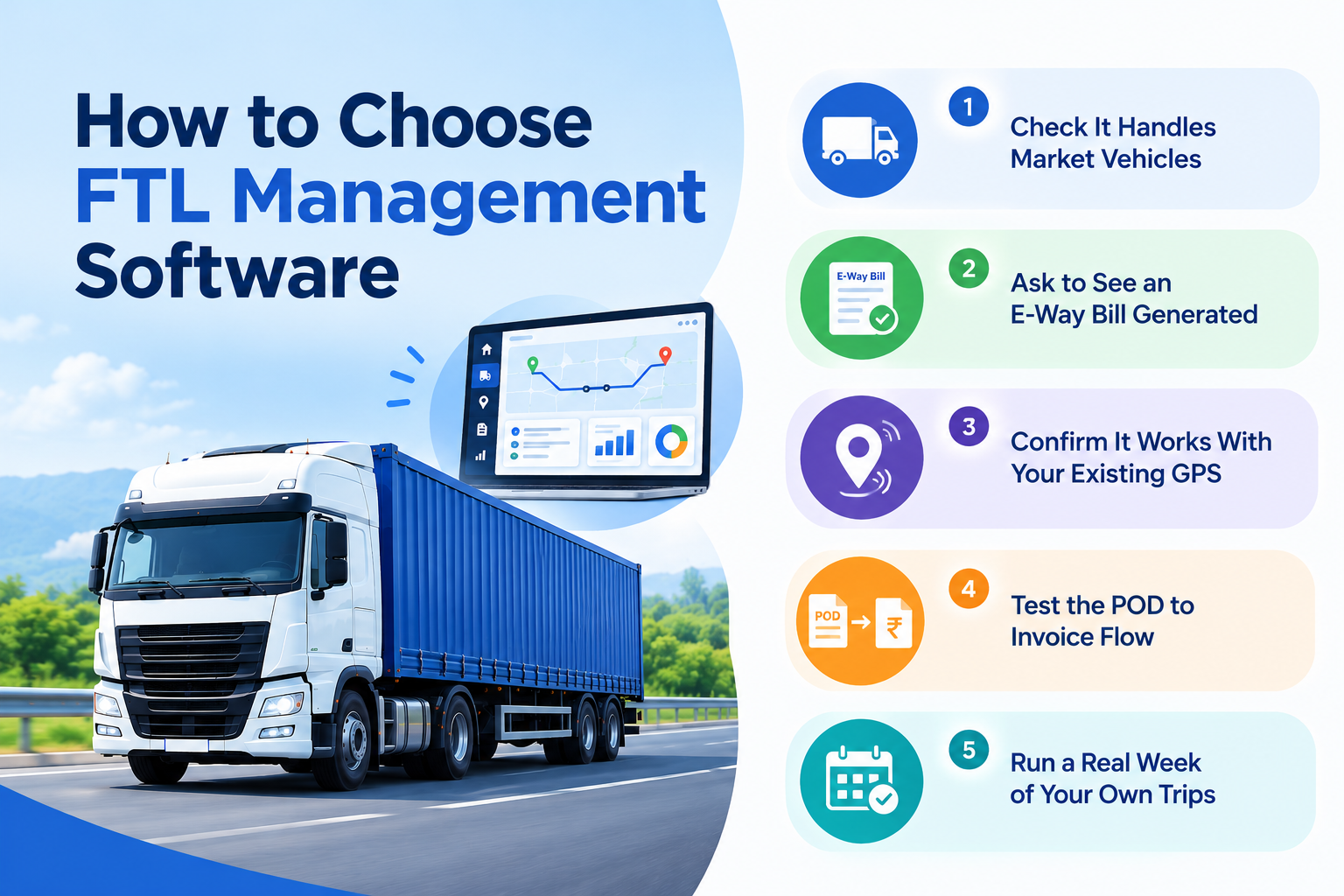
Work through these five in order. They are the checks that matter most for a transport business operating in India.
Plenty of software is built for companies that own every truck they run. Most Indian transporters do not.
Ask how supplier rates, advances, balances and detention are tracked. If the answer involves a spreadsheet, that platform was built for a different market.
On screen, from a trip record, start to finish. Then ask what happens when the bill is about to expire mid-transit.
Many platforms claim E-Way Bill support and mean a link to the government portal.
You already have devices fitted. Replacing them across thirty trucks is a cost nobody mentions during the demo.
Ask for the named list of GPS vendors the platform integrates with, in writing. LogiBrisk connects to the GPS devices most Indian fleets already run, so there is nothing to replace.
Have them approve a proof of delivery and show you the invoice it creates. This is where most of your billing delay disappears, so watch it happen rather than taking their word.
Demo data is always clean. Bring a real week with your own lanes, your own rate cards, and your own suppliers, and see where the system struggles.
Full truck load management software ties the trip together, from the indent a client sends on Monday to the freight you settle with the supplier a fortnight later.
Start with whichever part costs you most today. If invoices go out late, look at the POD flow. If market vehicle rates keep creeping up, look at rate history. Then shortlist two platforms rather than five.
If you also move part loads, check that the same platform covers both. Running full truckload management software and a separate PTL system means two sets of data and two monthly bills.
LogiBrisk covers both on one platform, and most transporters are running within two weeks. If it makes your shortlist, book a demo and bring your own data.
FTL stands for full truck load. A single client pays for the whole vehicle, and it runs direct from pickup to delivery without carrying anyone else's goods.
FTL means one client takes the whole truck and it runs point to point. PTL means several clients share the vehicle, so it makes multiple pickups and drops and takes longer. The software differs too, which is why PTL software works at the consignment level rather than the trip level.
No, not per trip. FTL costs more because you pay for the whole vehicle. It works out cheaper per tonne once your load fills most of the truck, which is usually above eight to ten tonnes.
LogiBrisk is a transportation management software for Indian logistics businesses, helping manage FTL and PTL operations, vehicle bookings, trip tracking, billing, and E-Way Bill compliance in one place.
Full Truck Load (FTL) ERP software helps transport businesses manage trip operations, accounting, GST returns, payroll, vehicle maintenance, and inventory in one system. Unlike trip management software that connects with Tally, an ERP can replace separate accounting software and is often better suited to larger fleets with multiple branches.
No. Good platforms handle both, because very few transporters move only one kind of load. Check this during the demo rather than assuming, since some software covers one and not the other.
Yes, the good ones do. The bill is generated from the trip record rather than typed again on the government portal, and you get an alert while there is still time to extend it.
Usually yes. Most Indian platforms connect to the common GPS vendors. Ask for the named list before you buy, because replacing devices across a fleet is an expensive surprise.
About two weeks. Loading clients, suppliers, lanes and rate cards takes a few days, and training your dispatch team takes the rest.