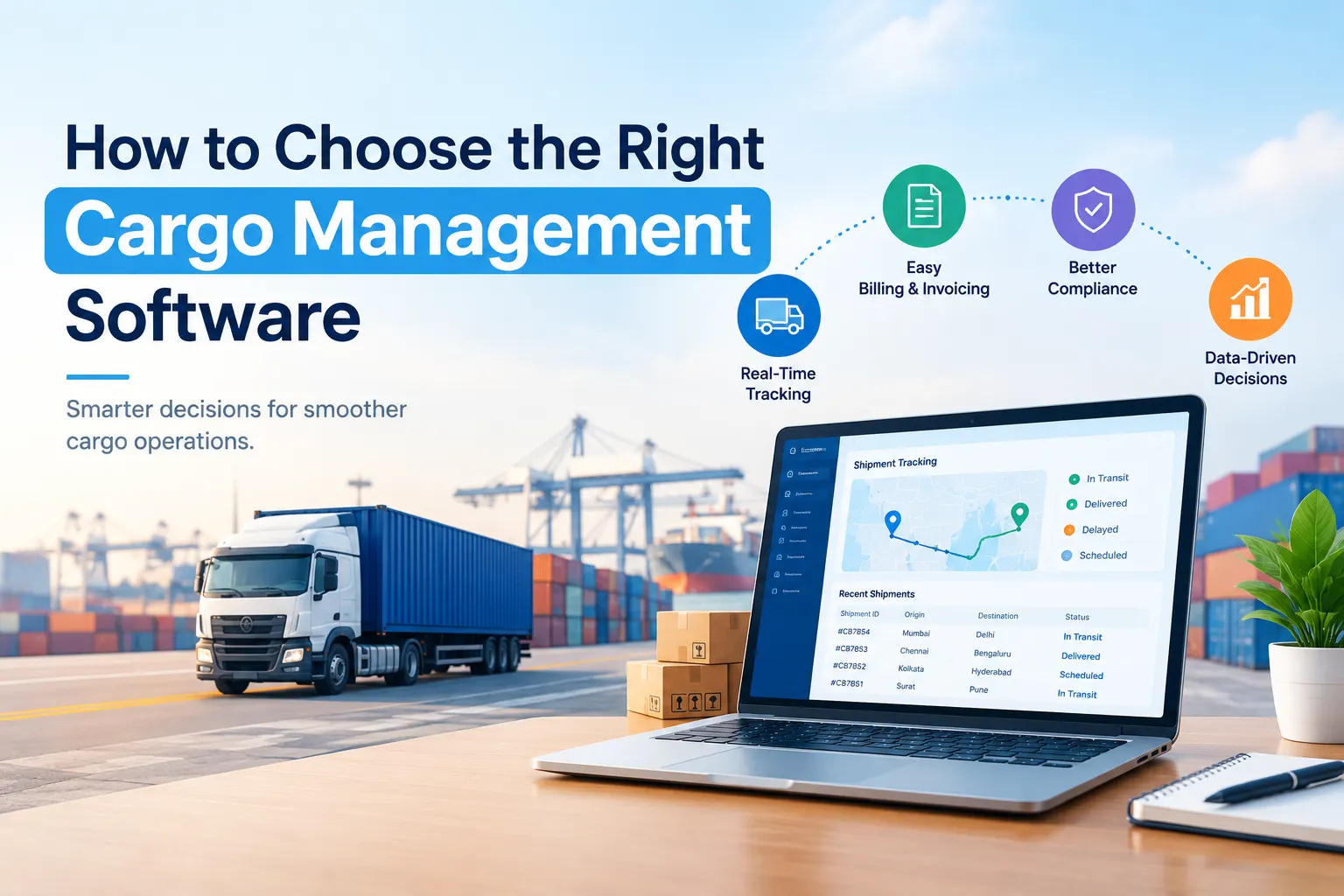
A cargo management system helps courier and express companies handle bookings, parcel scans, delivery proof, and billing in one place. Good cargo management software keeps express cargo movement smooth, from the booking counter to the customer's door. The wrong software gives your hub managers, drivers, and billing team a headache every day.
When scans are missed or dockets (booking records) are filled in by hand, parcels reach customers late. Invoices then get stuck for weeks.
This guide explains what a cargo management system does, which features matter most, what it costs in India, and how to pick the right one in 8 simple steps.
Key Takeaways
- Digital dockets stop lost paper records and typing mistakes at the booking counter.
- Hub-to-hub scanning gives you live express cargo tracking for every bag and parcel.
- Delivery proof uploaded from a phone helps you send invoices and collect money faster.
- Built-in GST billing and E-Way Bill creation (the document needed to move goods by road) help you avoid delays on the road.
- Test the software with your own real parcels before you buy, so your team will actually use it.
What Is Cargo Management Software?
Cargo management software, also called a cargo management system, is one digital system that handles bookings, parcel lists, hub scans, and billing for your cargo business. It keeps express cargo movement under control at every step.
It does four main things:
- Records each parcel at the booking counter (this record is called a docket)
- Groups parcels into bags for each hub (a sorting centre)
- Tracks long-distance trucks between your hubs
- Helps drivers deliver the parcel and collect proof of delivery (POD), such as a signature or OTP
It works for a small local courier, a regional express network, or a national carrier that handles thousands of parcels a day.
How Does It Work in Real Life?
Without software, counter staff write dockets by hand. When a parcel goes missing, someone phones the driver to ask where it is. At night, hub managers type paper lists into spreadsheets. Bags get misplaced, and customers get late updates.
If you want a deeper look at the basics, read our guide on what express cargo management software is.
With a cloud-based express cargo management system, a parcel's journey looks like this:
- Counter staff print a barcode docket in a few seconds.
- Parcels are grouped into a bag, and the bag gets its own barcode.
- Hub staff scan the bag when it arrives and when it leaves.
- Customers and managers see each update on the tracking page.
- The driver delivers the parcel and takes a signature or OTP on the phone.
- The system turns the delivered docket into an invoice.
The work is the same, but there is far less typing, and nobody argues about whose numbers are right.
What Should You Look for in Cargo Management Software in India?
Indian courier companies work with tight delivery times and high parcel volumes across many states. Your software must not slow down counter staff or hub workers. Look for these three things first:
- E-Way Bill and GST billing. Staff should not type docket numbers into government portals by hand during busy hours.
- A light driver app. Good express cargo delivery software lets drivers upload delivery photos and signatures right at the customer's door.
- Tracking across all branches. Your head office should see branch cash collections and vehicle departures on one screen. fleet management software also helps you send vehicles where the load is.
5 Key Features to Look for in Cargo Management Software
1. See All Branches on One Screen
- All branches in one view. See live docket counts, hub loads, and vehicle dispatches for every office on one dashboard, with no endless phone calls.
- Instant cloud updates. Branch staff create bookings, and head office sees the data right away.
- When it helps most. It is most useful when you open new branches and need parcel handovers to stay accurate across regions.
2. Track Each Parcel from Booking to Delivery
- Barcode bags. Group many dockets into one hub bag with a barcode sticker, so a single scan covers the whole bag.
- Live express cargo tracking. Parcel locations update automatically as trucks pass checkpoints. Linking with transportation management software gives you a clear view of long-distance truck schedules.
- Fewer customer calls. Customers can track their own parcels online with a tracking link.
3. Rates and Invoices Apply Automatically
- Saved rate sheets. Prices based on weight, distance, or size apply automatically when the docket is entered.
- Automatic invoices. Delivered dockets become GST bills with no re-typing of weight or fuel charges. A connected billing and accounts system also helps you avoid piles of unpaid bills.
- Fewer mistakes. Counter staff no longer make calculation errors during the busy evening rush.
4. Customers See Their Shipment in Real Time
- SMS alerts. Sender and receiver get a message when the parcel is picked up and delivered.
- Self-service portal. Business customers can track express cargo and download delivery reports and POD copies any time.
- More trust. Customers see each step of the journey, which builds confidence for high-value express shipments.
5. Works with Tally and Your Billing
- Accounts sync. Daily sales dockets, credit customer ledgers, and cash summaries go into your accounting software.
- Driver advance tracking. Record the cash given to long-distance drivers for tolls and diesel.
- Faster matching of payments. Bank deposits are matched with daily counter collections, so shortfalls show up early.
8 Steps to Choose the Right Cargo Management Software
Follow these steps in order to find the right software for your cargo management system and your daily branch work.
- Write down your problems first. Examples: missing PODs, long counter queues, or late billing.
- Set your budget. Count the software fee, barcode scanners, mobile phones, and staff training.
- Make two lists. Put must-haves (GST invoices, barcode scans) in one and nice-to-haves (like customer marketing tools) in the other.
- Check GST and E-Way Bill support. Make sure the system creates both directly.
- Try a demo with real trips. Ask your booking clerks and hub managers to enter real parcels on real routes.
- Test the delivery app on cheap phones. Check that barcode scanning works even without internet. Also ask whether your express cargo delivery software connects with last-mile delivery management software, so you can track riders up to the doorstep.
- Check how fast support replies. Test the vendor during your busy evening dispatch hours.
- Start small. Begin with one major hub, fix any problems, then roll it out to other branches.
Questions to Ask Every Vendor
- Can you show a demo using our own docket formats and branch routes?
- How long does hub setup take, and do you train our branch staff on site?
- What are your support hours when our night trucks face software errors?
- Can we export all our old shipment and customer data if we switch systems later?
- Do you charge extra when we open new branches or add more booking counters?
Run Express Cargo Movement Without Paper Registers
Busy courier hubs need fast barcode scanning, automatic bag lists, and simple dispatch control. The right express cargo management system replaces paper registers and keeps parcels moving across every branch.
LogiBrisk Express Cargo Management Software gives you a clear view of your whole parcel network. It includes:
- Booking and docket creation
- Bag and parcel list (manifest) creation for each hub
- Fast hub-to-hub scanning
- Live tracking of delivery times and service levels
- A delivery app for drivers with POD capture, so shipments close right at the door
- Customer tracking links and branch performance reports
Contact us to modernise your hub dispatches and cut parcel delays.
Conclusion
Good express cargo management software gives you a clear view of every booking, hub dispatch, and doorstep delivery. Replacing paper registers with barcode scans makes parcels move faster and cuts costly delivery mistakes.
List what your branches need, involve your hub staff in the demos, and choose a cargo management system that can grow along with your fleet.
Frequently Asked Questions
Why do express delivery companies need a cargo management system?
Express companies handle thousands of small parcels every day across many hubs. A cargo management system creates barcode dockets, makes hub bag lists, tracks long-distance trucks, and sends customers SMS updates. This helps prevent lost parcels and hub delays.
Can cargo software create GST invoices and E-Way Bills directly?
Yes. Good logistics software calculates GST based on parcel weight or destination zone and creates GST invoices. It also connects to government portals to issue E-Way Bills, so nobody has to enter the same data twice.
How does mobile POD work for parcel deliveries?
The driver opens the app, sees the day's deliveries, and scans the parcel barcode at the door. The customer signs on the phone or gives an OTP. The proof then uploads straight to the main system.
Is cargo tracking software right for a small courier business?
Yes. Cloud plans let a small company with two or three branches use strong features at a fair price. You pay per user or by parcel volume and upgrade as your network grows.