




Last-mile delivery is the most expensive leg of shipping. It takes the largest share of total shipping costs. If you run a logistics, courier or e-commerce operation, it is the first place to look for savings.
Most of this cost comes from a few fixable causes: unplanned routes, failed deliveries, manual dispatch and missing data. This guide explains what last-mile delivery costs include and gives you 10 practical ways to reduce them, plus the numbers to track.
Key Takeaways
- Last-mile delivery takes the largest share of total shipping costs, so it is the biggest place to save.
- Labour, fuel, failed deliveries and paperwork drive most of the cost.
- Better routes and fewer failed first attempts are the fastest ways to cut costs.
- Automated dispatch, live tracking and photo or OTP proof of delivery reduce delays, disputes and manual work.
- Three numbers show whether you are saving: cost per delivered order, first-attempt delivery rate and the share of parcels returned to the sender.
What Are Last-Mile Delivery Costs?
Last-mile delivery costs are all the expenses of moving a parcel from the local hub to the customer's door. The distance is short, but every parcel needs its own stop, address and hand-over, which is why the cost is high.
Last-mile delivery costs typically include:
- Labour: rider and driver wages, incentives and overtime. This is usually the largest share.
- Fuel and vehicles: fuel, repairs, servicing and depreciation.
- Failed deliveries and returns: repeat trips and return-to-origin (RTO) shipments.
- Time at the stop: searching for addresses and waiting for customers, which adds labour hours.
- Admin and paperwork: manual dispatch, paper proof of delivery (POD), cash-on-delivery (COD) reconciliation and E-Way Bills.
- Customer support: calls about delays and missing parcels.
Many businesses know their fuel bill but not their cost per delivered order (total last-mile cost divided by orders delivered). That number is where cost reduction starts.
Last-Mile Delivery Costs: Challenges and Solutions
Costs stay high when delivery information is scattered across calls, chats and paper. These are the most common causes, with the matching tip for each fix.
- Unclear addresses: riders search by landmark and parcels go undelivered. Fix: capture exact addresses (tip 4).
- COD refusals: you pay for the trip and the return. Fix: control refusals (tip 5).
- Poor route planning: routes built from memory add distance and fuel use. Fix: plan routes with software (tip 1).
- No live visibility: delays surface only through customer complaints. Fix: track vehicles live (tip 7).
- Failed first attempts: the same parcel needs repeat trips. Fix: confirm time slots and send alerts (tip 3).
- No rider accountability: you cannot see who delivered what. Fix: review cost data by rider (tip 10).
- Manual paperwork: lost or late delivery slips slow billing and COD reconciliation. Fix: use digital proof of delivery (tip 8).
For the India-specific view, read Last-Mile Delivery Challenges in India and How to Fix Them.
10 Proven Ways to Reduce Last-Mile Delivery Costs
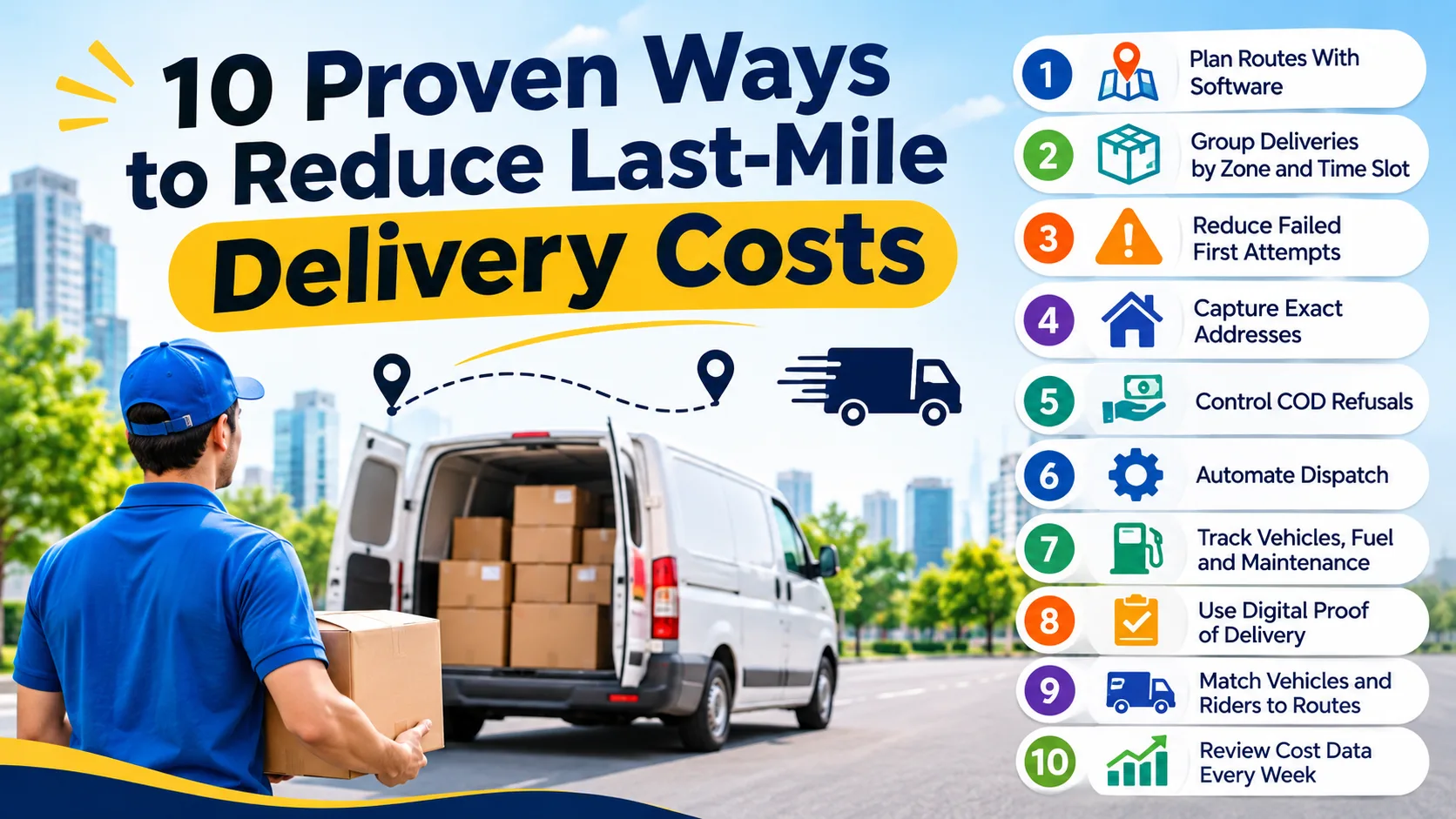
Explore 10 practical ways to reduce last-mile delivery costs, improve route planning, minimize failed deliveries, optimize fleet operations, and increase delivery efficiency.
1. Plan Routes With Software
Routes built from memory add distance, uneven workloads and fuel use. Route optimization orders stops by location, time window and vehicle capacity, so each rider drives less and delivers more. See our last-mile delivery management software.
2. Group Deliveries by Zone and Time Slot
More stops per kilometre lowers the cost per parcel. Cluster orders by area, set cut-off times and offer delivery slots, so one rider covers a dense zone. For example, assign one rider to one area for the morning slot instead of sending three riders across the city.
3. Reduce Failed First Attempts
Every failed attempt is a second trip you pay for. Confirm the order and time slot before dispatch, then send status alerts by SMS, WhatsApp or app. For example, message the customer the evening before: "Your parcel arrives tomorrow between 10 AM and 1 PM."
4. Capture Exact Addresses
Landmark-based directions waste rider time. Collect a full address, pin code and map pin at checkout, and flag incomplete addresses before the parcel leaves the hub.
5. Control COD Refusals
Confirm COD orders before dispatch, offer a small incentive for prepaid payment and track COD collection digitally. For example, send a message asking the customer to confirm the order and keep the cash ready.
6. Automate Dispatch
Automatic allocation assigns each order to the nearest available rider and balances workloads, so dispatchers handle only exceptions. Before you pick a tool for this, review these 7 things to check before you choose.
7. Track Vehicles, Fuel and Maintenance
Live tracking shows where every vehicle is, so you can reroute around delays and spot idling or detours. Fuel tracking and planned maintenance cut fuel waste and breakdowns.
8. Use Digital Proof of Delivery
Photo or OTP-based POD gives instant, searchable proof of delivery. It removes lost slips, reduces disputes and speeds up billing and COD reconciliation.
9. Match Vehicles and Riders to Routes
Use delivery data to assign vehicle type by load and distance. A large van on a three-parcel route wastes fuel, and a two-wheeler on a bulky route wastes trips.
10. Review Cost Data Every Week
Dashboards show which routes, zones and riders cost the most. Review them weekly and fix the worst performers first. For example, if one zone has many failed deliveries, fix its addresses and time slots before anything else.
Key Numbers to Track to Confirm You Are Saving Money
Track these three numbers before and after each change:
- Cost per delivered order: total last-mile cost ÷ orders delivered. This is your true unit cost.
- First-attempt delivery rate: orders delivered on the first try ÷ orders attempted. It shows how many trips are wasted.
- RTO rate: orders returned to origin ÷ orders dispatched. It shows the cost of refusals and failed deliveries.
Compare them again after 30 days to see what changed.
How Logibrisk Software Helps You Cut Delivery Costs
Logibrisk's last-mile delivery management software brings planning, dispatch, tracking and proof of delivery into one system, built for Indian roads, traffic and delivery conditions.
- Route optimization for shorter routes and lower fuel use
- Automated dispatch that assigns each order to an available driver
- Customer notifications on status, delays and changes, so fewer deliveries fail
- Live tracking of vehicles and shipments, so you can reroute around delays
- Fuel and maintenance management to cut fuel waste and breakdowns
- Digital POD with photo and OTP verification, for fewer disputes and faster billing
- Billing, invoicing and COD tracking for less manual reconciliation
- E-Way Bill automation to generate and manage bills in one place
- Real-time reports and analytics to see which routes and riders cost the most
Because the system connects with your ERP, CRM and e-commerce platforms, orders flow in without re-entry. You can see how the full workflow runs in our Smart Last-Mile Delivery Management System.
Conclusion
Last-mile delivery costs respond quickly to a few changes: smarter routes, fewer failed attempts, automated dispatch and digital records. Start by measuring cost per delivered order, first-attempt delivery rate and RTO rate, then fix the biggest leak first.
Not sure which tool fits your business? Compare the top 10 last-mile delivery management software in India before you decide.
Ready to see how much you could save? Schedule a free demo.
Frequently Asked Questions
What Are Last-Mile Delivery Costs?
They are all the expenses of the final leg of a shipment, from the local hub to the customer's door. They include labour, fuel, vehicles, failed deliveries, returns, paperwork and customer support.
Why Is Last-Mile Delivery So Expensive?
Each parcel needs its own stop, address and hand-over. Labour is the largest share, and failed attempts, poor routes and manual processes add more.
Can Small Businesses Reduce Last-Mile Costs Without a Big Budget?
Yes. Clean up addresses at checkout, confirm COD orders, group deliveries by zone and track cost per delivered order. Add software once volumes grow.
How Do I Choose Last-Mile Delivery Software?
Check for route optimization, live tracking, digital POD, COD handling, integrations and suitability for local roads.