Logistics Software
Top 10+ Logistics Software Companies in India (Updated 2026)
You sit through the demo. Everything works. The truck moves across the map, the invoice appears, the dashboard looks clean.
Three months later your team is back on the old spreadsheet.
That does not happen because the software was bad. It happens because it was built for a different kind of business than yours.
Below are twelve logistics software companies working in India today, each with the problem it actually fixes, so you can find the two or three built for a business like yours. After that, seven questions worth asking in your next demo.
Logistics management software handles the work that used to run on phone calls and spreadsheets. Booking a trip, assigning a vehicle, tracking it on the road, generating the E-Way Bill, and raising the invoice at the end.
Some platforms do all of that in one place, which is what a full logistics management software in India is built to do. Others handle one part very well and nothing else. Nearly all the cloud logistics software companies working in India today are SaaS only, so there is no server to buy and nobody to hire.
That difference matters more than any feature list. A delivery app will not raise your freight invoice, and a freight TMS will not plan a courier's city route. Picking the wrong type is the most expensive mistake in this market, and it has nothing to do with price.
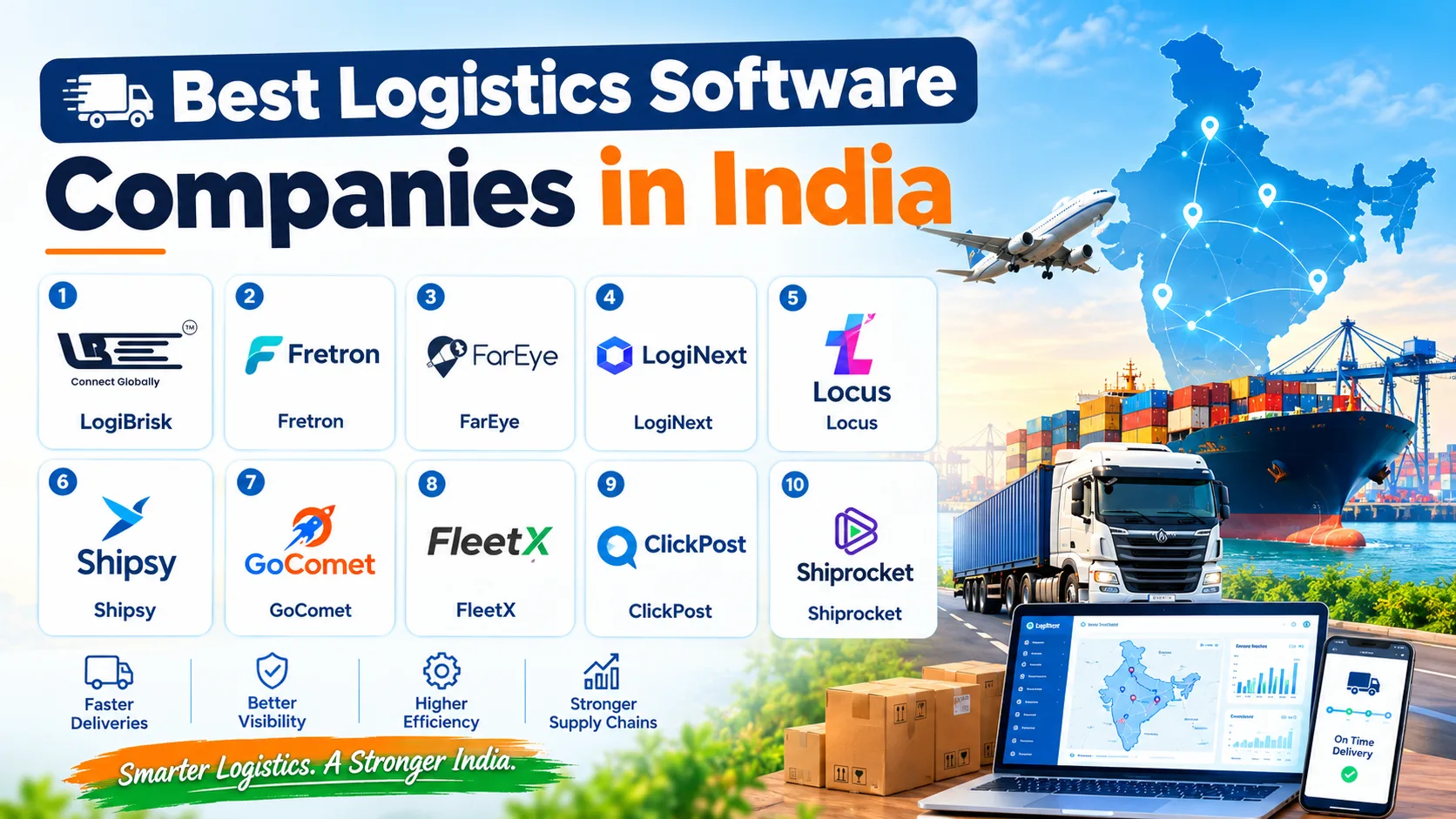
These are the twelve logistics software companies most Indian businesses look at. Each one shows what it does, who it suits, and the problem it solves. The numbers are for reference only. This is not a ranking, because the right platform depends entirely on what you move.
Every demo looks good. That is what demos are built for.
These seven questions are how you find out whether the software actually fits your business. Ask the same seven in every demo, write down the answers, and compare them afterwards.
Reason behind the ask: Demo data is always clean. Yours will not be, and messy data is where software falls over. Ask at the start of the call, not the end. Give them a real week of your trips, your own addresses, your own rate cards.
Reason behind the ask: A platform built for containers will not run your Gujarat to Nashik lane. One built for city couriers will not handle your long-haul billing. Ask for two or three customers in your own line of work, at roughly your size. If they offer you one to phone, that is a good sign.
Reason behind the ask: This is the quickest way to tell whether the software was built for India or adapted for it later. Ask them to show it on screen, from the trip record, start to finish. Then ask what happens when a truck is delayed and the bill is about to expire. Our guide to E-Way Bill compliance explains why that expiry matters.
Reason behind the ask: If it will not, your accountant enters every invoice twice. That is somebody's afternoon, every day, for as long as you use the software. Name whatever you actually use, Tally or anything else, and ask to watch an invoice move across. Most vendors say they integrate. Fewer can show it. Our guide to GST billing software covers what a working sync looks like.
Reason behind the ask: The best platform on this page fails if your driver closes the app and phones the office instead. Put one of your own drivers on it during the call and watch without helping him. If he is stuck in the first two minutes, nothing else in the demo matters. The same applies to any fleet management software you are evaluating.
Reason behind the ask: Nobody asks this, which is exactly why it works. Every platform has gaps, and you want to hear about them now rather than in month three. A vendor who names two or three honest limitations is worth more than one who says it does everything. The second answer is never true.
Reason behind the ask: The quoted price is rarely the full price, and the go-live date is where mid-market and enterprise platforms differ most. Ask what is billed separately. GPS hardware, onboarding, training, and support outside office hours are the four that usually sit outside the quote. Then ask for a go-live date in writing. Mid-market platforms run in weeks. Enterprise ones take months.
Shortlist two platforms, not five. Two demos you prepare for beat five you sit through.
Pick them from the list above using the "problem it fixes" and "who it is for" lines. Then take the seven questions into both calls and write the answers down while you are still on the line.
LogiBrisk and Fretron for domestic road freight, FarEye, LogiNext and Locus for last-mile delivery, and Shipsy for international logistics. Which is top depends entirely on what you move.
For road transport, the best logistics software companies are the ones offering all-in-one logistics management software rather than a single-function tool, because dispatch, GST, and billing need to share one trip record.
Globally, SAP, Oracle, and Blue Yonder are largest by revenue. Within India, Shipsy, FarEye, and LogiNext are the best funded among the pure-play logistics software companies.
For route planning and rate benchmarking, yes, because both are hard for people to do well. For predictive ETAs, ask the vendor to prove it on your own data first.
Mid-market platforms usually charge per vehicle or per transaction, per month. Enterprise platforms sell modules separately and can run into lakhs a year. Most vendors do not publish pricing.
Cloud, in almost every case. No server cost, no IT staff, and compliance updates arrive on their own. On-premise only makes sense where internal IT policy demands it.