Transportation Software
What is TMS Software? A Complete Guide for Indian Logistics
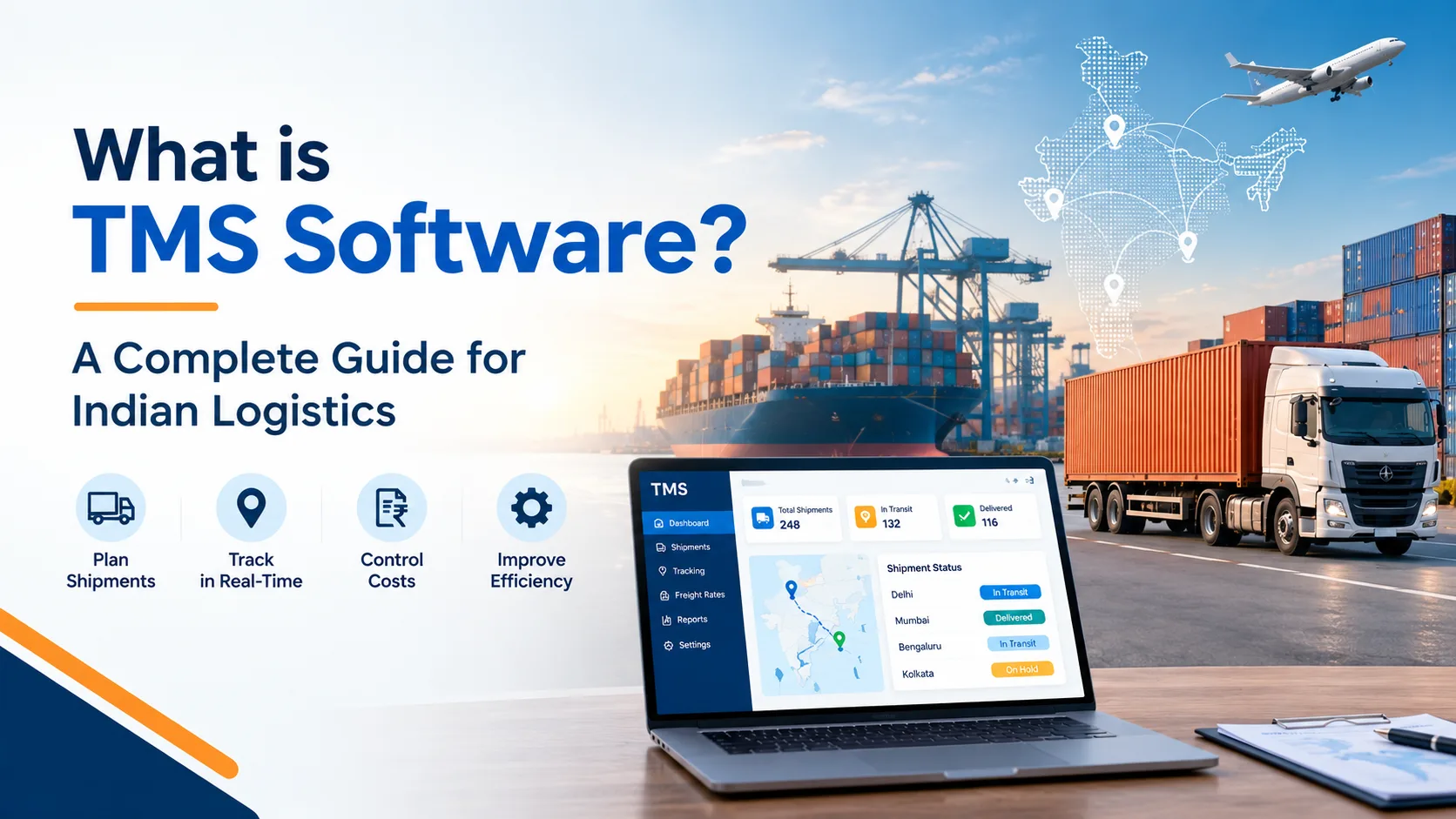
India's logistics industry is enormous, and it is only getting bigger. The market was valued at over USD 455 billion in 2025 and is expected to reach nearly USD 855 billion by 2035. Road freight alone accounts for 55% of all goods movement in the country, with millions of trucks crisscrossing state lines every single day.
Yet despite this scale, a large number of Indian logistics companies' fleet owners, 3PLs, transporters, and manufacturers are still managing operations the old way. Phone calls for vehicle assignments. Excel sheets for route planning. Manual invoices at the end of every month. WhatsApp groups for driver coordination.
The result? Delays, billing errors, fuel waste, compliance headaches, and a constant feeling that the business is running you rather than the other way around.
This is exactly the problem that TMS software is built to solve. If you have heard the term but are not entirely sure what it means or whether your business actually needs it, this guide will give you a clear, honest answer. Whether you are a fleet owner, a 3PL, or a manufacturer, understanding TMS software logistics is the first step toward running a smarter operation.
TMS stands for Transportation Management System. In simple terms, it is software that helps logistics companies plan, execute, track, and optimise how goods move from one place to another. The full term Transportation management software India tells you exactly what it does: it manages every aspect of how your transport network operates, from vehicle assignment to final delivery.
Think of it as the central control room for your entire transport operation. Instead of managing routes on paper, tracking vehicles through phone calls, and generating invoices manually, the TMS brings all of that into one digital platform that works automatically, in real time.
From the moment a shipment is booked to the moment it reaches the customer and the invoice is settled, the TMS handles it. Your team stops spending time on coordination and starts spending time on decisions that actually grow the business.
For Indian logistics companies dealing with GST compliance, E-Way Bill requirements, multi-state operations, and a fragmented fleet network, a TMS transport management system is not just useful; it is necessary.
The process is simple when you look at it step by step. Transportation Management Software helps businesses manage each stage of transportation, from booking a shipment to confirming delivery.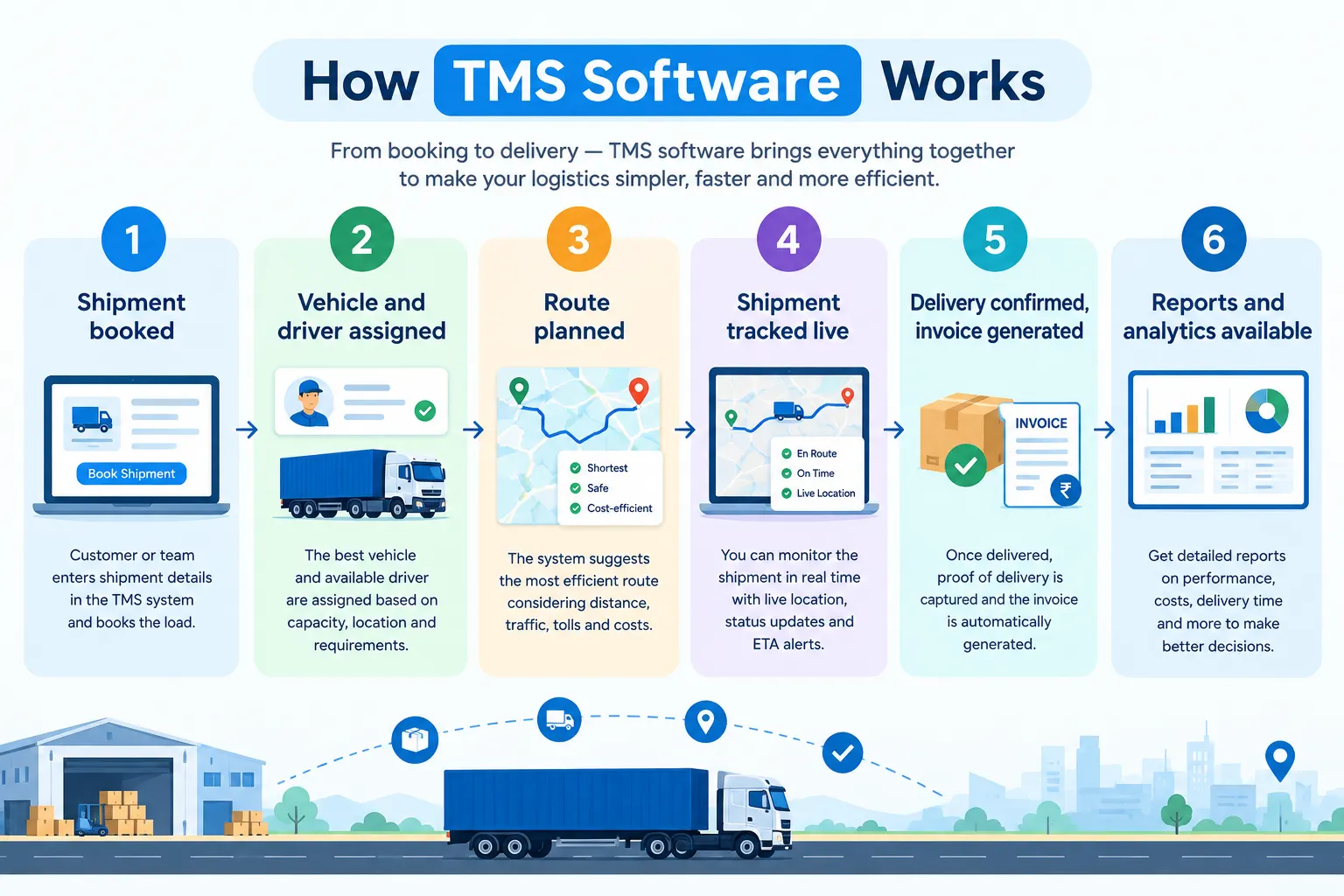
The process starts when a shipment is booked. Details such as the pickup location, delivery destination, cargo type, weight, and delivery priority are added to the system. This keeps all shipment information in one place.
The system checks available vehicles and drivers and helps assign the right resources for each shipment. It considers factors such as vehicle capacity, location, and shipment requirements.
TMS software helps plan an efficient delivery route based on distance, traffic, tolls, and delivery deadlines. This helps drivers follow a clear route and can reduce unnecessary travel time.
GPS tracking allows the operations team to see the shipment location during transit. Customers can also receive shipment updates, making it easier to know when the delivery is expected.
Once the shipment reaches the destination, the delivery can be confirmed digitally. Proof of delivery (POD), delivery time, and other important details can be recorded in the system.
After delivery, the system can calculate charges based on predefined rates and shipment details. This makes invoice preparation easier and reduces the need for manual calculations.
The TMS dashboard brings important information together in one place. Businesses can review delivery times, fuel costs, vehicle usage, driver performance, and billing details to understand their transportation operations better.
Overall, TMS software connects the main steps of transportation in one system. It reduces manual work, improves visibility, and helps logistics teams manage daily operations more efficiently.
Not all TMS platforms are built the same. Here are the features that genuinely matter for Indian logistics operations:
Manual route planning is one of the biggest sources of fuel waste and delayed deliveries. TMS software uses AI-based algorithms to calculate the most efficient routes automatically, considering live traffic, distance, toll points, and time windows. Studies show that AI-powered route optimisation reduces fuel costs by 15 to 25% and cuts average delivery times significantly. For a company running 50 or 100 vehicles daily, those savings add up fast.
Your customers want to know where their goods are. Your operations team needs to know if something goes wrong. Real-time GPS tracking built into the TMS gives both live location updates for every vehicle, with instant alerts if a delivery is delayed or a route is deviated. No more calling drivers to check status.
Managing your own fleet or working with multiple carrier partners becomes dramatically simpler with a TMS system logistics. Vehicle health monitoring, driver performance tracking, trip assignment, and capacity management all happen from one dashboard. For companies running their own vehicles, a built-in fleet software module means you no longer need a separate system to monitor your fleet; everything is connected. India has a fragmented fleet of 12 million small truckers coordinating across that landscape, and without proper software is nearly impossible at scale.
Billing errors are one of the most common and costly problems in Indian logistics. Wrong rates, missed charges, and disputed invoices all of these eat into your margins and damage client relationships. TMS software generates invoices automatically based on actual trip data, distance covered, weight carried, and applicable charges, eliminating human error. When combined with a smart accounting software integration like Tally, your billing and accounts receivable run as one seamless process with zero manual reconciliation.
This is non-negotiable for any logistics company operating in India. A good TMS generates E-Way Bills automatically as part of the dispatch process, no separate login, no manual data entry, no last-minute scrambling before a truck leaves the yard. GST reconciliation is handled within the system, keeping your compliance clean without additional effort.
What gets measured gets managed. The TMS dashboard gives you a real-time view of your entire operation delivery performance, vehicle utilisation, fuel efficiency, revenue per trip, and outstanding payments. Instead of piecing together reports from five different places at the end of the month, you see everything in one place, updated live.
When Indian logistics companies implement TMS software properly, they can see measurable improvements across their operations:
Let’s look at the common problems that TMS software can help solve. Many Indian logistics companies face several of these challenges in their daily operations:
TMS software can help different types of businesses manage transportation more efficiently. It is especially useful for businesses that handle regular shipments, multiple vehicles, or complex delivery operations.
TMS software is becoming increasingly useful as logistics operations become more complex. Businesses that rely heavily on manual processes can use it to improve visibility, reduce repetitive work, and manage transportation more efficiently.
TMS software automates key logistics tasks, while manual processes rely on spreadsheets, calls, and paperwork. Here’s how they differ in daily operations.
| Factor | Manual Logistics | TMS Software |
|---|---|---|
| Route Planning | Time-consuming and depends on manual planning | Automated route planning |
| Shipment Tracking | Requires phone calls or manual updates | Real-time GPS tracking |
| Billing | Manual calculations can lead to errors and disputes | Automated billing based on shipment data |
| GST / E-Way Bill | Manual processes and higher risk of errors | Automated generation and management |
| Scalability | Difficult to manage as shipment volume grows | Easier to handle higher shipment volumes |
| Cost Efficiency | Higher operational effort and manual costs | Helps reduce operational and transportation costs |
With several options available, here are the key factors to consider before making a decision. Choosing the best TMS software for your business is not about picking the most feature-heavy platform; it is about finding one that fits your operations, your team, and your compliance requirements from day one:
GST and E-Way Bill integration must be built-in, not an add-on. Any TMS you use in India needs to handle this natively.
The system should integrate with existing hardware or provide built-in tracking features, ensuring seamless operations when using advanced FTL management software.
Cloud TMS means no expensive hardware, automatic updates, and access from anywhere. Cloud-based TMS platforms offer SaaS pricing models with no upfront IT cost and short deployment cycles, making them ideal for growing Indian businesses.
Standalone billing tools create more work. The TMS should handle invoicing internally, with integration to Tally or other accounting systems you already use.
A good TMS system software provider should have you live within days, not months. If implementation requires a six-month project, look elsewhere.
Logistics does not follow office hours. Your software support should not either.
Logibrisk is built specifically for Indian logistics and transportation businesses.
Offers route optimization, real-time tracking, automated billing, driver management, and freight analytics in one platform.
Supports FTL, PTL, express cargo, 3PL, and e-commerce delivery management software.
Includes advanced FTL management and last-mile delivery management features.
Trusted by 500+ enterprises with 1 Billion+ shipments managed successfully.
Fast 5-day onboarding with easy integration to GPS, FASTag, and Tally systems.
Helps businesses reduce manual work, improve efficiency, and streamline logistics operations.
India's logistics industry is at an inflection point. The companies growing profitably right now are not the ones with the most trucks or the most staff; they are the ones with the best systems running their operations.
TMS software is not a luxury reserved for large enterprises. It is a practical tool that pays for itself quickly through fuel savings, billing accuracy, compliance automation, and the operational capacity to handle more business without adding proportional overhead.
If your logistics company is still managing routes on Excel and tracking vehicles through WhatsApp, the gap between you and your competitors is widening every day.
TMS software is a platform that helps logistics companies plan, execute, track, and optimise the movement of goods, covering route planning, real-time tracking, fleet management, billing, and compliance in one system.
It automates manual processes, provides real-time shipment visibility, reduces fuel costs through route optimisation, eliminates billing errors, and handles GST and E-Way Bill compliance automatically.
Yes, good TMS software like Logibrisk has built-in GST and E-Way Bill integration, making compliance automatic rather than a manual task.
With Logibrisk, businesses go live within 5 working days. The team handles all configuration and staff training as part of onboarding.
Absolutely. Modern cloud-based TMS software scales to your business size, whether you operate 10 vehicles or 1,000, the platform adjusts to your needs without requiring a large IT investment upfront.