
Why Indian Transporters Need GST-Integrated Logistics Software
If you run a transport business in India, GST compliance is no longer something you can manage on the side. It is right at the centre of your daily operations, and in 2026, it has become stricter, faster, and far less forgiving of manual mistakes.
Every truck that leaves your yard for a consignment valued above ₹50,000 needs a valid E-Way Bill before it moves. Not after. Not on the way. Before. Miss it, and the consequences are immediate vehicle detention, goods seizure, and a penalty of ₹10,000 or the amount of tax evaded, whichever is higher.
The problem is not that Indian transporters do not know the rules. Most do. Generating E-Way Bills manually takes time and increases the risk of errors. Teams must log into the GST portal, enter invoice details, fill Part A and Part B separately, and track expiry manually. The GST system now catches these errors in real time, making manual processes slower and riskier for transport businesses.
That is exactly why GST-integrated logistics software is no longer optional for serious transport operations. Businesses across India are transitioning to the E-Way Bill software. transporters can rely on software that generates documents automatically, tracks expiry in real time, and keeps every truck compliant before it leaves the yard. This guide explains what it is, what problems it solves, and why transporters switching to it are staying compliant without the daily stress.
What is GST-Integrated Logistics Software?
GST-integrated logistics software is a transport management platform with GST and E-Way Bill compliance built directly into the dispatch process, automatically, not manually. Think of it as a complete GST enabled transport software that handles document generation, expiry tracking, and audit records without your team touching the GST portal for routine shipments.
In a manual setup, dispatch creates a shipment, someone logs into the GST portal, generates the E-Way Bill, and hands it to the driver. Three steps, three people, three chances for error.
With GST-integrated software, the moment a shipment is created, the E-Way Bill is generated automatically. Part A and Part B are filled. Document attached. The driver gets it before the truck moves every time, without exception.
GST Compliance Challenges Indian Transporters Face Daily
Let us be direct about what manual GST compliance actually looks like on the ground:
E-Way Bill generation before every dispatch
Every consignment above ₹50,000 needs one. For a transporter moving 50 trucks a day, that translates to 50 separate portal logins, 50 manual data entries, and 50 opportunities for a mistake to slip through.
Part B was not filled before departure
An E-Way Bill with only Part A filled is legally invalid for road movement. This is one of the most frequent violations because accounts teams generate Part A well in advance, but dispatch teams delay vehicle assignment. The result is a truck on the road with an invalid document.
E-Way Bill expiry during transit
For standard cargo, validity is one day for every 200 km. If a vehicle is delayed due to a breakdown, road closure, or congestion, the E-Way Bill must be extended within 8 hours before or after expiry. Manually tracking expiry for multiple vehicles simultaneously is nearly impossible.
GSTIN validation blocks
In 2026, E-Way Bill generation can be blocked automatically if GST returns are pending, the GSTIN is inactive, or transporter details are incorrect. If your team does not catch this before dispatch, the truck does not move.
Multi-state compliance complexity
Different states have different intra-state E-Way Bill thresholds. A transporter moving goods across Gujarat, Maharashtra, and Rajasthan in the same week needs to track different rules for each state manually, on top of everything else.
Invoice and E-Way Bill mismatches
Even minor inconsistencies, such as mismatched invoice values or incorrect HSN codes, can trigger compliance actions in 2026. The GST system now cross-verifies documents automatically, and mismatches are flagged without any manual intervention from authorities.
How GST-Integrated Logistics Software Solves These Problems
Automated E-Way Bill Generation
Automated E-Way Bill generation software pulls invoice data directly from the dispatch record, no separate portal login, no manual re-entry, no mismatch risk. No lorry receipt is issued before the E-Way Bill number is confirmed. The document is ready before the truck moves every single time.
Real-Time GST Compliance Tracking
A live compliance dashboard shows the status of every active E-Way Bill across your fleet, which are valid, which are expiring soon, and which need an extension. Instead of manually checking each truck, the system flags what needs attention automatically. Your team responds to alerts, not phone calls.
E-Way Bill Extension and Cancellation
When a vehicle breaks down or the route is delayed, extensions can be initiated up to 8 hours before or after expiry, capped at 360 days from the original generation date. One action from the trip dashboard updates the validity and keeps the truck moving legally. For cancelled shipments, the software handles cancellation within the required 24-hour window automatically.
GSTR Filing Made Simple
A good smart last mile delivery software logistics businesses rely on maintains accurate, audit-ready records of every trip, invoice, and compliance document, so monthly GSTR filing becomes a simple data export rather than a month-end scramble. For transporters previously dependent on a CA for basic compliance, this significantly reduces that cost.
Key Benefits of GST-Integrated Logistics Software for Transporters
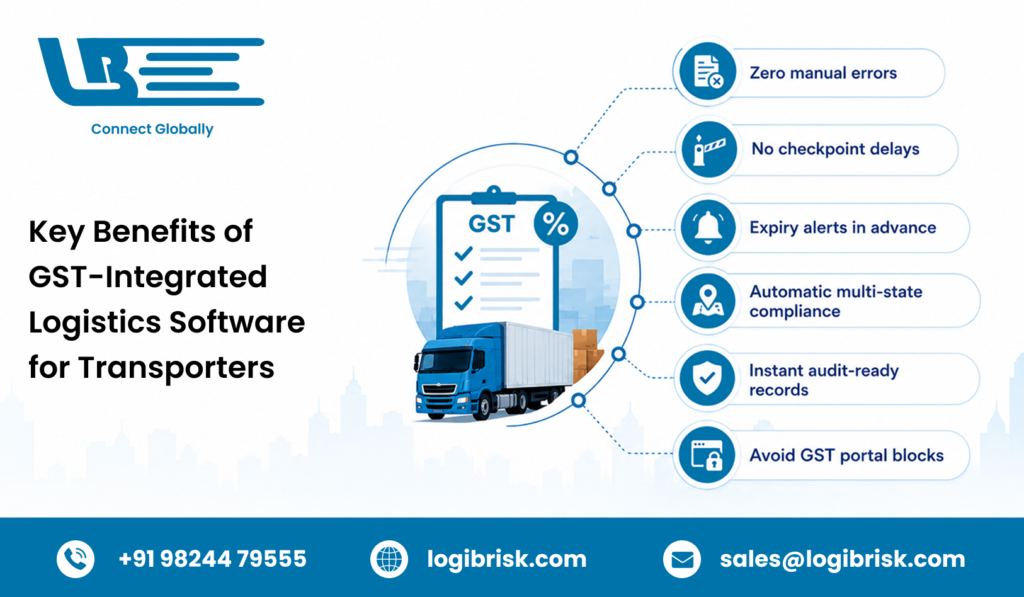
The impact of switching from manual to integrated GST compliance shows up quickly:
- Zero manual errors – Auto-generation from invoice data eliminates the mismatches that trigger penalties and detention
- No checkpoint delays – Every truck leaves with a valid, complete E-Way Bill already attached to the trip
- Expiry alerts in advance – The system notifies you before a document expires, not after
- Automatic multi-state compliance – Different thresholds and rules for different states are managed within the platform without manual tracking
- Instant audit-ready records – Every E-Way Bill, every extension, every cancellation is stored and retrievable instantly
- Avoid GST portal blocks – The software validates GSTIN status and filing compliance before dispatch, not during
With automatic E-Way Bill management linked to the dispatch and tracking system, for a transporter, this has become the most trusted means for compliance without having to enter manual details for each and every dispatch.
Who Needs GST-Integrated Logistics Software Most?
Not every business has the same compliance exposure, but these types of operations feel the pain most acutely without integrated software:
– Road freight companies (FTL/PTL) – High daily shipment volumes mean high daily E-Way Bill volume. Manual management breaks fast.
– 3PL logistics providers – Managing compliance across multiple clients, multiple consignors, and multiple states simultaneously is impossible without a centralised system.
– Fleet owners (10+ vehicles) – Once you cross this threshold, manually tracking E-Way Bill expiry and extension across your fleet becomes a full-time job in itself.
– Manufacturing companies – Regular inter-plant and supplier-to-warehouse movements mean constant E-Way Bill generation. Integration with the dispatch system removes the compliance burden from the production team entirely.
– Express cargo companies – Time-sensitive shipments have zero tolerance for compliance delays. With built-in express cargo tracking, the software generates a valid E-Way Bill before departure. It tracks consignments in real time, so time-critical deliveries aren’t held up by compliance issues.
– E-commerce logistics providers – High volumes of daily shipments across multiple states, with strict delivery windows, make automated compliance non-negotiable. With GST filing software India built into the same platform, E-Way Bills are generated for every qualifying shipment automatically, so your last-mile team focuses on delivering, not on compliance paperwork.
What to Look for in GST-Integrated Logistics Software
Choosing the right platform matters. Here is what actually makes a difference:
- E-Way Bill generation: This must happen automatically, not as a manual trigger. If someone has to remember to generate the document, errors will happen.
- Real-time GST portal: The software should validate GSTIN status, check filing compliance, and confirm document validity against the live portal, not just generate documents in isolation.
- E-Way Bill expiry alerts: Proactive notifications for documents approaching expiry, not just records of what has already expired.
- Multi-state compliance support: Different intra-state thresholds and rules should be handled by the platform, not tracked manually by your team.
- Tally and accounting integration: Invoice data should flow directly from your accounting management software into the logistics platform, eliminating duplicate data entry and keeping billing and compliance records perfectly in sync.
- Easy onboarding: The best platforms are live within days, not months, and require no dedicated IT infrastructure to run.
- 24/7 support: GST compliance issues do not wait for business hours. Neither should your support team.
Why Indian Transporters Choose Logibrisk for GST Compliance
Logibrisk is a powerful GST compliance TMS software built specifically for Indian road freight operations. It automates E-Way Bill generation, tracks expiry in real time, manages extensions, and stores all compliance documents in one audit-ready platform.
By integrating compliance directly into dispatch and tracking workflows, Logibrisk reduces manual work, avoids delays, and simplifies GST operations for transport businesses.
Trusted by over 500 enterprises and used for more than 1 billion shipments, the platform supports FTL, PTL, express cargo, last-mile, and 3PL logistics operations across India.
With onboarding completed in just 5 working days, Logibrisk helps transporters stay compliant and operational from day one.
Conclusion
GST compliance in India is not getting simpler. In 2026, E-Way Bill compliance becomes less manual-friendly. The system checks everything first; if the invoice date, GST filing, or login is not right, the goods do not move at all.
For Indian transporters still generating E-Way Bills manually and tracking expiry through phone calls and spreadsheets, the question is not whether mistakes will happen. It is how expensive the next one will be.
GST-integrated logistics software removes that risk entirely by making compliance automatic, accurate, and invisible to your daily operations.
Most Indian transporters are still generating E-Way Bills manually and risking GST penalties every single day. Get a Free Consultation with Logibrisk and see how GST-integrated logistics software eliminates compliance stress from day one.
FAQs
Q1: What is GST-integrated logistics software?
It is a transport management platform where GST and E-Way Bill compliance is built directly into the dispatch process, generating E-Way Bills automatically, tracking expiry in real time, and maintaining audit-ready compliance records without manual portal access.
Q2: How does GST logistics software help Indian transporters?
It eliminates manual E-Way Bill generation errors, tracks document expiry across the entire fleet, manages multi-state compliance automatically, and ensures every truck leaves with a valid document before departure.
Q3: Can GST logistics software generate E-Way Bills automatically?
Yes. When a shipment is created in the system, the E-Way Bill is generated automatically from the invoice data, and no separate login to the GST portal is required.
Q4: Is GST-integrated software suitable for small transporters?
Absolutely. Even transporters with 10 to 15 vehicles benefit significantly from automation. The reduction in manual errors, penalty risk, and compliance time pays for the software quickly.
Q5: How quickly can I implement GST logistics software?
With Logibrisk, businesses go live within 5 working days. The team handles all configuration, GST portal integration, and staff training as part of the onboarding process.