Fleet Management
Fleet Maintenance Checklist: 12 Checks Every Transporter Follows
A fleet maintenance checklist is a fixed routine of daily, weekly, monthly and kilometre-based vehicle checks that catches small faults before they become breakdowns. The 12 checks below cover tyres, fluids, brakes, battery, filters, servicing, inspection and compliance.
A truck that breaks down on the highway often costs more than a month of regular maintenance. There is the towing charge, the repair bill, the driver sitting idle, the delayed delivery, and the customer who now doubts you. Most breakdowns start with something small nobody checked low coolant, a worn tyre, an overdue oil change.
This fleet maintenance checklist gives transport owners, fleet managers and supervisors 12 key checks their drivers and workshop team can actually follow. Each one tells you what to look at, how often, and who is responsible.
A fleet maintenance checklist is not a cost. It is the cheapest insurance a transport business can buy. Here is what regular checks protect you from:
Many of these costs do not show up on one invoice, which is why they are easy to ignore. We covered them in detail in Hidden Fleet Costs: 5 Money Leaks and How to Fix Them.
The 12 checks below are grouped by how often you should do them: daily, weekly, monthly, and quarterly or yearly.
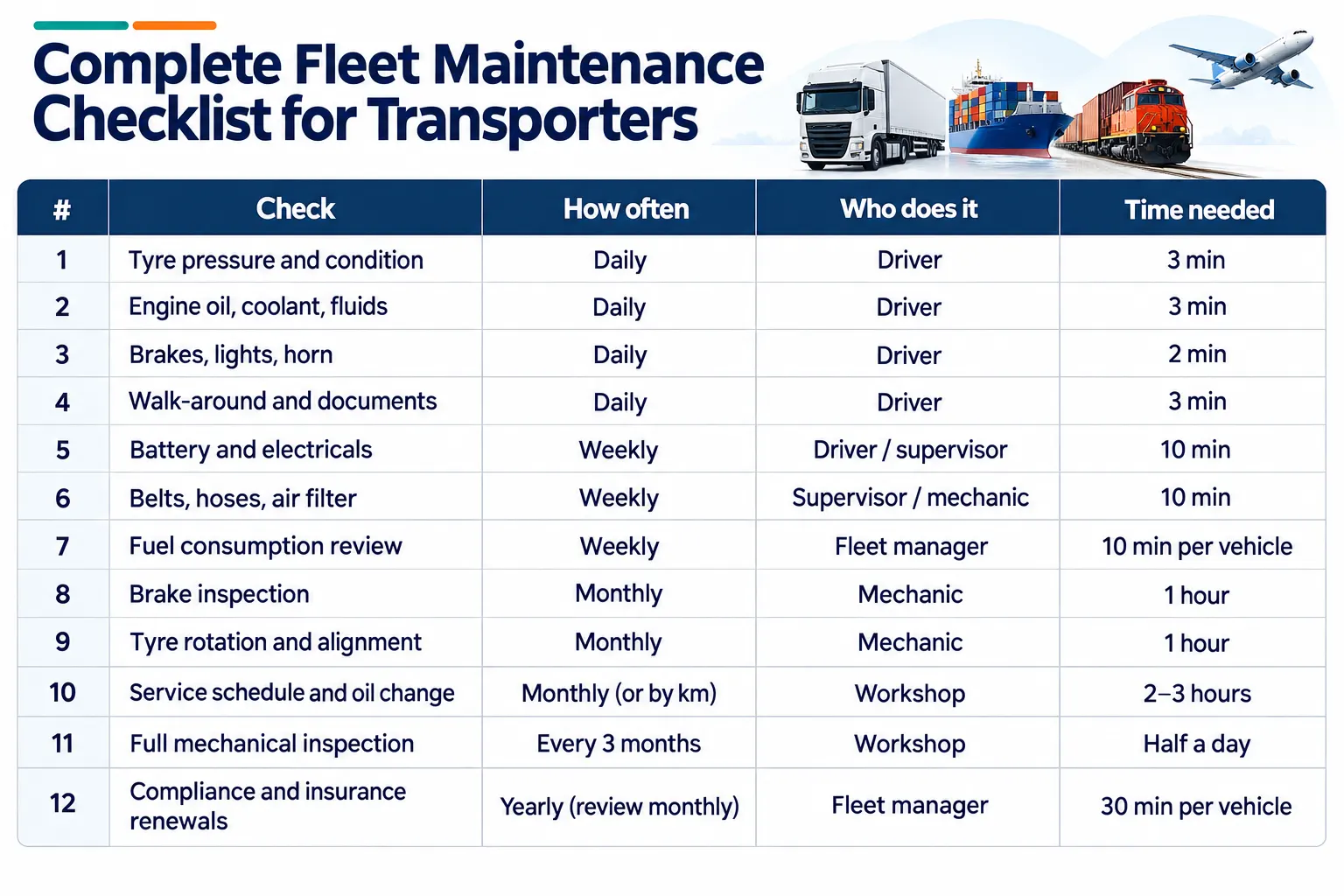
This part of the fleet maintenance checklist takes the driver 5 to 10 minutes before starting. They catch the problems that cause most roadside breakdowns.
Check all tyres, including the spare. Look for low pressure, cuts, bulges and uneven wear. Under-inflated tyres burn more fuel and are the most common cause of blowouts in summer. Keep the correct pressure written on a sticker near the driver's seat so there is no guessing.
Check the engine oil level, coolant level, brake fluid and windscreen washer fluid. A low coolant level is the fastest way to damage an engine, especially on long highway runs in hot weather. Top up if needed and report any fluid that keeps going down that means a leak.
Press the brake pedal and feel for softness or a longer travel than usual. Walk around the vehicle and check headlights, indicators, brake lights, reverse lights and the horn. A broken tail light is a small thing that causes rear-end accidents at night.
Look for fluid under the vehicle, loose parts, damaged mirrors and anything hanging below the chassis. Check that the RC, insurance, fitness certificate, PUC and permit are in the vehicle and valid. Also confirm the E-Way Bill and LR for the trip are ready before leaving the yard.
Tip: Give drivers a one-page daily checklist to tick and sign. If you use a driver app, they can complete it on their phone and the office sees it instantly.
The weekly part of the fleet maintenance checklist is done when the vehicle is back at the yard or branch. They take 20 to 30 minutes.
Check the battery terminals for white or green corrosion and make sure the clamps are tight. Look at the water level in non-sealed batteries. A weak battery usually fails on a cold morning or after the vehicle has stood for a few days, which is exactly when you need it most.
Open the bonnet and look at the fan belt and other drive belts for cracks or fraying. Squeeze the radiator hoses they should be firm, not soft or swollen. Check the air filter; on dusty routes it clogs quickly, and a clogged filter increases fuel consumption and reduces engine power.
Compare this week's fuel used against the kilometres run for each vehicle. A sudden drop in mileage is an early warning: it could be a mechanical problem, a tyre issue, or fuel being misused. Reviewing this weekly, not monthly, means you catch the problem after one bad week instead of four.
Tip: Fuel checks are much easier when trip kilometres, fuel entries and GPS data are in one place. A smart fleet management system shows the mileage per vehicle automatically, so you do not need to calculate it by hand.
These need a mechanic or your workshop team. Book them on a fixed date each month so they are never skipped because the vehicle was "too busy".
Have the brake pads, drums or discs and brake lines inspected. Measure pad thickness and check for uneven wear, which points to a problem with one wheel. Brakes on a loaded truck do a lot more work than on a car, so monthly is the minimum for heavy vehicles.
Rotate tyres so they wear evenly, and check alignment and balance. Bad alignment wears out a set of tyres months early and pulls the vehicle to one side, which tires the driver. Also check the wheel nuts are tightened to the correct torque.
Check each vehicle's odometer against its service schedule. Engine oil, oil filter, fuel filter and gearbox oil each have a kilometre or time limit set by the manufacturer. Follow whichever comes first. Keep the service record for every vehicle; it protects your warranty and helps when you sell the vehicle.
Tip: Set a reminder per vehicle at, say, 500 km before the next service is due. Fleet maintenance software can send this alert automatically based on the odometer reading from GPS, so you never rely on memory.
These are the bigger items. They cost more, but skipping them is how a small repair becomes an engine rebuild.
A thorough check of suspension, steering, clutch, exhaust, chassis and body. Look for cracked leaf springs, worn kingpins, loose steering and rust on the chassis. For trailers, check the kingpin, landing gear and coupling. Fix small problems now while they are cheap.
Track the expiry dates of every vehicle's fleet management documents: fitness certificate, insurance, PUC, permits and road tax. Driving with an expired document means a challan at the next check post and a rejected insurance claim if there is an accident. Renew at least 15 days before expiry.
For your drivers, check licence validity and medical fitness as part of the same review. This is what fleet risk management software is built to track: most risks are not mechanical, they are paperwork that nobody followed up.
Tip: Keep all documents in a digital vehicle file with expiry dates, and set alerts 30 days before each renewal per vehicle and per driver.
Most fleets do not fail because the owner does not care. They fail because the fleet maintenance checklist routine breaks down. Watch for these:
If you recognise two or more of these, the fix is usually not more effort. It is a better system. If you are comparing options, our Fleet Management Software Guide for Transport Businesses explains what to look for.
A fleet maintenance checklist on paper works for 5 vehicles. At 20, 50 or 200 vehicles, someone has to remember every service date, every document expiry and every driver's report. That is where fleet maintenance software takes over.
Here is what good fleet maintenance management software does with the 12 checks above:
LogiBrisk's fleet management software is a logistics fleet management software built for transporters in India. It connects maintenance with your trips, E-Way Bills, billing and GPS tracking in one platform.
A fleet maintenance checklist is not complicated: four quick checks every day, three every week, three every month, and two bigger reviews through the year. What matters is doing them every time, for every vehicle, and keeping a record.
Start this week. Print the table above, hand the daily checks to your drivers, and fix a monthly workshop date for each vehicle. Within a month you will see fewer surprises on the road and a clearer picture of what each truck really costs you.
When the fleet grows and the paper routine starts slipping, that is the moment to move it into software. Book a free demo of LogiBrisk and we will show you how the 12 checks run automatically across your fleet.
Most commercial trucks need servicing every 10,000 to 20,000 km or every 3 to 6 months, depending on the manufacturer's recommendations. Trucks that carry heavy loads or travel on dusty and hilly roads may need more frequent servicing.
Preventive maintenance means checking and servicing a vehicle regularly to prevent problems. Reactive maintenance means repairing a vehicle after something goes wrong or it breaks down. Preventive maintenance helps reduce repair costs and keeps trucks running smoothly.
Yes. Fleet maintenance software is useful even for transporters with just 5 vehicles. It helps track service dates, document expiry dates, fuel usage, and repair records. This makes it easier to manage vehicles without missing important maintenance tasks.
A daily vehicle checklist should include tyres, engine oil, coolant, brakes, lights, and checks for leaks or visible damage. Drivers should also check that the vehicle's documents are valid. These checks usually take less than 10 minutes.
Follow a regular maintenance schedule, check fuel usage every week, and fix reported problems as soon as possible. Keep records of servicing and repairs to identify vehicles that cost more to maintain. This helps you control expenses and make better maintenance decisions.
The best fleet management software in India should help transporters manage vehicle maintenance, tracking, billing, and important documents in one place. LogiBrisk helps transporters manage E-Way Bills, LR/Bilty, GST billing, GPS tracking, service reminders, and fuel reports through one platform. It helps fleet owners monitor vehicle expenses and manage daily transport operations more easily.