Fleet Management
Best Fleet Management Software for Indian Transporters in 2026
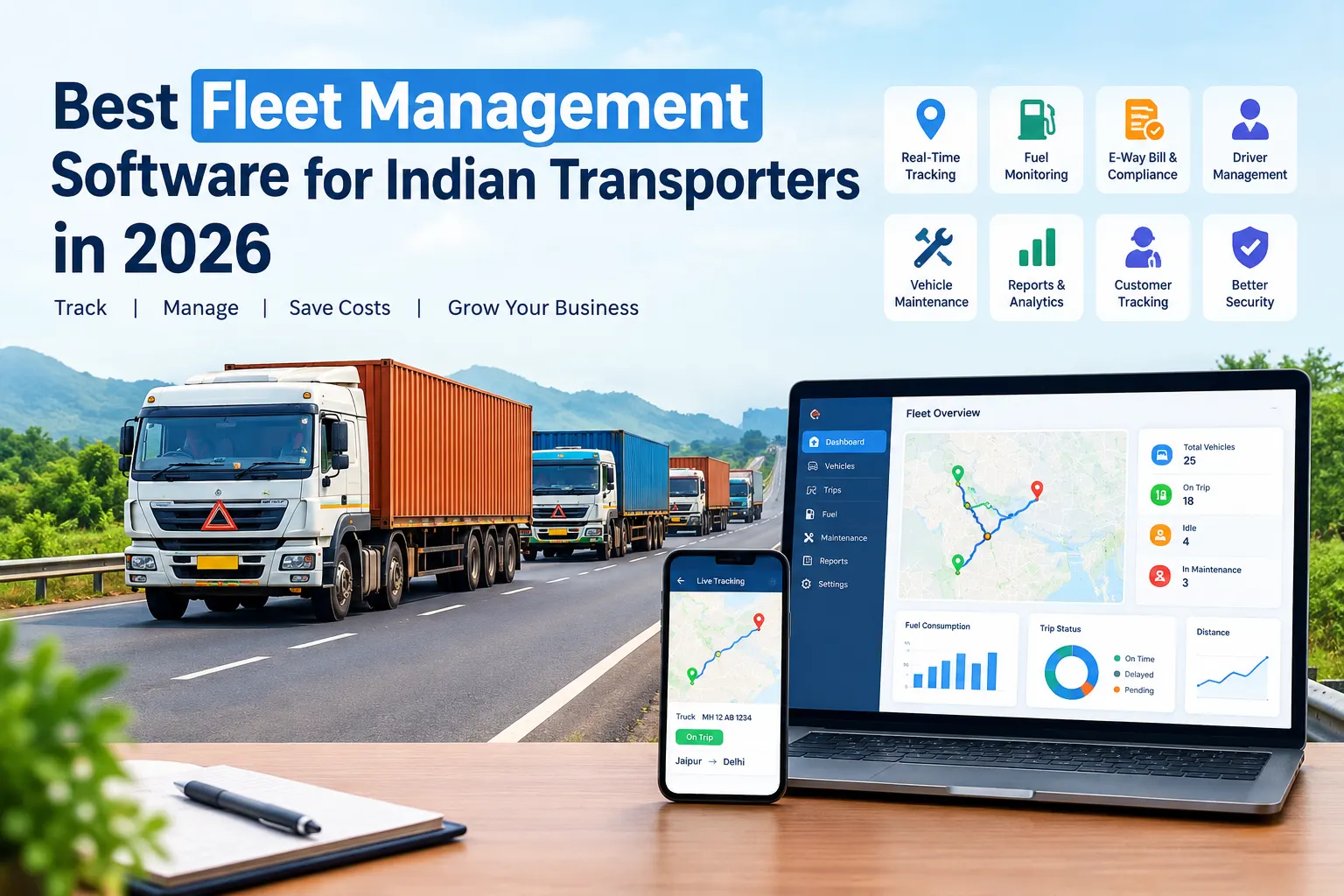
If you are running a transport business in India, you already know how chaotic it can get. Trucks across multiple states, drivers hard to reach, fuel bills climbing with no explanation, and customers calling every hour asking where their shipment is. Managing all of this manually works up to a point, but beyond 10 to 15 vehicles, it starts breaking down fast.
This is exactly why fleet management software for Indian transporters has become a must-have in 2026. Not a luxury. Not something only big companies use. A practical tool that helps you control your fleet, cut unnecessary costs, and run your business with confidence.
In this guide, we have covered everything real problems Indian fleet owners face, what to look for in good software, and an honest comparison of the best options available today. Let us get into it.
At its core, fleet management software is a digital platform that helps you track, manage, and optimise everything related to your vehicle operations, all from a single dashboard.
Think of it as a control room for your entire fleet. You can see where every vehicle is at any given moment, know how much fuel each truck has consumed, get instant alerts when a driver deviates from the planned route, and generate reports that show you exactly how much each trip is costing versus earning.
But modern fleet management platforms go much further than just GPS tracking. They cover vehicle maintenance scheduling, driver behaviour analysis, trip planning, customer notifications, E-way bill compliance, and even integration with FASTag data for toll management.
The technology has matured significantly over the last few years, and what was once available only to large enterprises with IT departments is now accessible to a single-truck operator running out of a small office in Surat or Ludhiana.
Let's be honest, running a transport business in India has never been a walk in the park.
You're managing dozens of trucks spread across multiple states, chasing drivers who go off-route, dealing with fuel theft that eats into margins, and trying to keep up with customers who want live delivery updates. At the same time, diesel prices keep climbing, highway tolls are adding up, and a new government compliance rule seems to drop every other month.
Most fleet owners I've spoken to describe their day something like this: wake up to four missed calls from different drivers, spend the morning firefighting a breakdown somewhere on NH48, and then spend the afternoon explaining to a client why their consignment is three hours late with zero real-time data to back up any explanation.
This isn't a small problem. India's road freight industry moves over 70% of the country's goods. The transporters running this industry, from small operators with five trucks to large logistics companies managing 500+ vehicles, are the backbone of Indian commerce. But far too many of them are still running operations on WhatsApp groups, handwritten registers, and gut instinct.
That's exactly why fleet management software for Indian transporters has gone from a "nice to have" to a genuine business necessity in 2026.
The Indian transport landscape has some very specific challenges that generic global software often misses. Here's what makes this market unique and why purpose-built fleet management software for Indian roads and regulations makes such a difference.
In India, fuel typically accounts for 35–40% of a transporter's total operating cost. Pilferage by drivers, siphoning at dhabas, and inaccurate mileage claims bleed money silently. Software that tracks fuel consumption against GPS distance can flag anomalies almost immediately. This is exactly where fuel monitoring software for trucks India pays for itself often within the first two or three months of use.
Breakdowns, diversions, seasonal route changes, and state border checkposts are daily realities. A good fleet management system lets dispatchers reroute trucks in real time and communicate changes to drivers on the ground without ten back-and-forth calls.
From E-way bills under GST to Fastag mandates and AIS-140 GPS device requirements, transporters are dealing with an increasingly regulated environment. Missing a compliance window can mean fines, delays, or detained vehicles. Software that automates reminders and integrates with government portals removes a lot of that risk. Having reliable e-way bill generation software built into your operations is no longer optional — it is essential.
The Amazons and Flipkarts of the world have trained Indian consumers and B2B buyers to expect real-time shipment tracking. If your competitors offer live tracking links and you're giving manual call-back updates, you're already losing business without realising it.
Harsh braking, speeding on highways, and unauthorised stoppages directly impact your vehicle wear and your accident risk. Software that monitors and scores driver behaviour helps fleet managers address problems with data, not arguments.
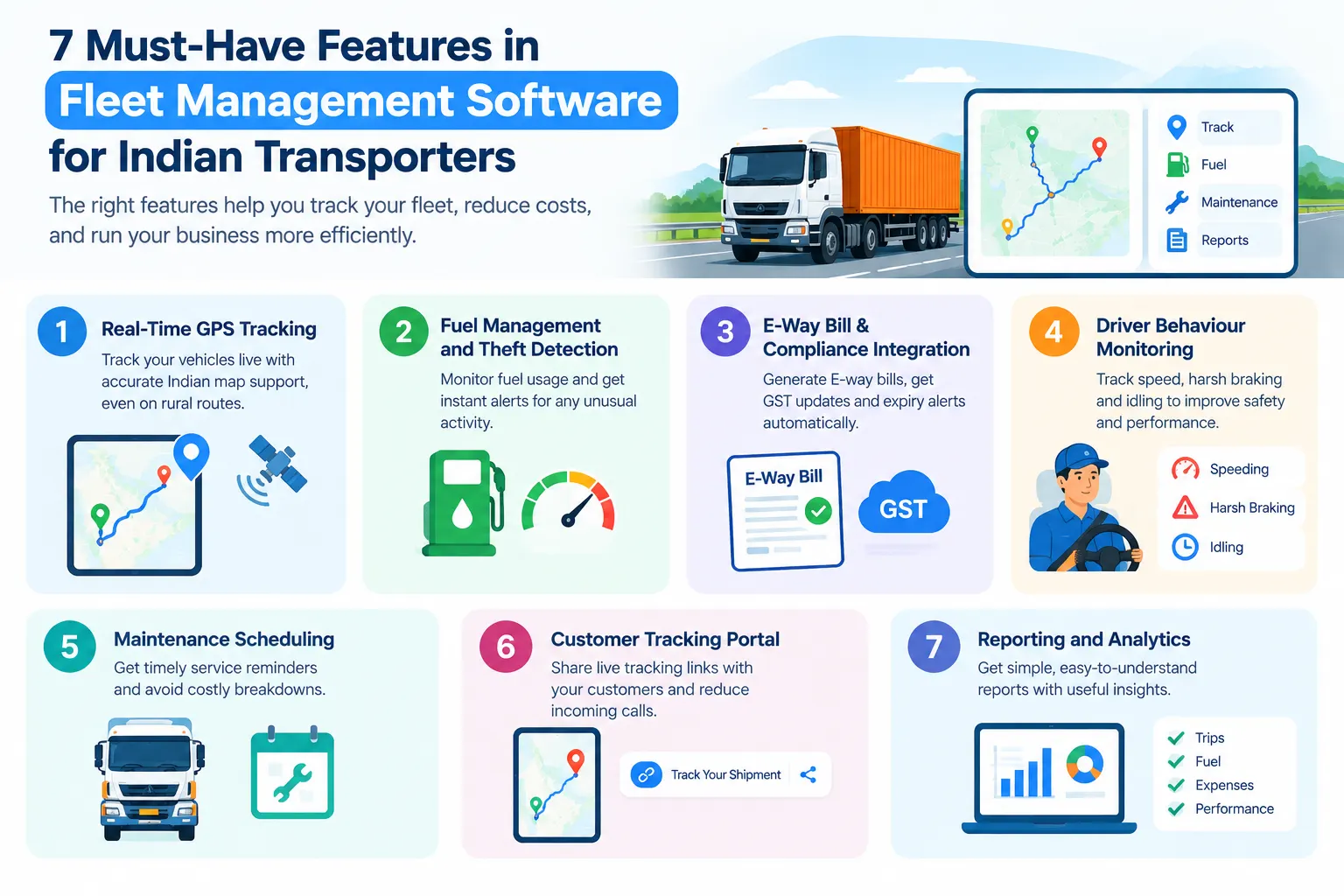
Not all fleet software is created equal, and for Indian operators specifically, some features are non-negotiable. Here's what to look for:
This sounds obvious, but the quality of GPS tracking varies wildly. You need a system that works reliably across rural highways, not just metro areas. It should integrate with Indian mapping data, including lesser-known state highways and show accurate movement even in low-connectivity zones through offline data syncing.
Look for software that cross-references fuel fill data with actual GPS mileage. Any significant gap between expected and actual fuel efficiency should trigger an automatic alert. Bonus points if it integrates with fuel card systems popular in India.
Manual E-way bill generation is tedious and error-prone. The best smart fleet management system for Indian transporters will integrate directly with the GST portal, auto-populate trip data, and send expiry alerts so your drivers are never caught on the road with an expired document.
Speeding alerts, harsh braking events, and prolonged idling should all be tracked and scored. Some platforms even let you gamify this with driver leaderboards, which creates healthy competition and genuinely improves performance.
Reactive maintenance is expensive. Proactive scheduling based on mileage, engine hours, or calendar intervals prevents breakdowns before they happen. The software should automatically flag upcoming service intervals and track repair history for each vehicle. This is what separates a basic GPS tool from proper fleet maintenance management software.
Your clients shouldn't have to call you to know where their consignment is. A good platform lets you share a live tracking link with customers so they can check the status themselves. This alone reduces your incoming call volume significantly.
Data is only useful if you can understand it. Look for platforms that generate reports in straightforward language, with visual dashboards that don't require a data analyst to interpret. A solid billing and accounting solution integrated into the same platform means your trip data, invoices, and payment status all live in one place saving your team hours every week.
Many transporters hesitate when they hear "software subscription." The instinct is to understand another monthly expense on top of diesel, driver salaries, and maintenance. But that framing misses the real question entirely: what is not using fleet management software actually costing you right now?
The answer, for most Indian fleet operators, is a lot more than the software ever would.
Studies on Indian fleet operations consistently show that fuel losses from theft, siphoning, or inflated mileage claims are significant across unmonitored fleets. Even a modest saving per vehicle per month adds up quickly when you're running 20 or 30 trucks. Fleet software with fuel monitoring typically pays for itself within the first few months on fuel savings alone before you've even counted any other benefits.
Drivers inflate mileage claims or report false fuel fills
Siphoning at night halts or dhabas go completely undetected
Without consumption vs. distance cross-referencing, there's no way to catch it
Even saving 2–3 litres per truck per day across 20 trucks adds up to lakhs annually
A vehicle detained at a checkpost because of an expired permit or fitness certificate doesn't just cost you the fine. It costs you the delay, the spoiled relationship with the customer, and often the entire revenue from that trip. These are completely avoidable costs. Proper document tracking eliminates this risk without anyone having to remember anything manually.
Expired E-way bills, fitness certificates, permits, and insurance cause detention
Fines range from ₹10,000 to ₹25,000 per incident, plus the business disruption
Manual tracking via registers and WhatsApp reminders is unreliable at scale
Software auto-alerts before expiry, so nothing slips through
Without route optimisation, drivers take longer routes—sometimes genuinely, sometimes intentionally. Every extra kilometre driven is fuel spent, more wear on the vehicle, and a slower delivery. In E-commerce Delivery Management Software, this inefficiency becomes even more critical. Multiply that across your fleet over months, and you're looking at a substantial hidden cost that never shows up as a single line item but quietly drains your margins every single day.
Drivers detour for personal stops or take familiar but longer routes
No way to verify planned vs. actual route without GPS data
Extra km = extra fuel + extra tyre wear + delayed deliveries
Route deviation alerts catch this in real time, not after the fact
Manual freight billing is slow and error-prone. Disputes over charges, incorrect LR details, and missing documentation all of it delays payments from clients. Automated billing speeds up the entire process and cuts the back-and-forth that ties up your accounts receivable. Getting paid faster isn't just a cash flow benefit; it reduces the administrative burden on your team significantly.
Wrong LR numbers, incorrect weight entries, and missing PODs delay invoices
Clients dispute charges when the documentation doesn't match
Payment cycles stretch from 30 days to 60–90 days unnecessarily
Automated billing tied to trip data eliminates most of these errors at the source
When you add these four cost categories together across even a 15–20 truck fleet, the number is rarely small. The software investment looks very different when you're comparing it against what you're actually losing, not just what you'd be spending.
Here is an honest look at the leading options available today. The focus is on what each one actually does well and where it fits without the usual marketing spin.
LogiBrisk is the only platform on this list that combines a full Transport Management System with fleet tracking under one roof. No juggling between separate tools, everything lives in one dashboard.
Complete trip lifecycle: order creation → vehicle assignment → live tracking → delivery confirmation
GST-compliant freight billing and invoicing built in
E-way bill integration with auto-expiry alerts
Fuel monitoring with pilferage detection
Driver behaviour scoring and route deviation alerts
Customer tracking portal shareable via WhatsApp link
Works for fleets from 5 trucks to 500+
India-first support team that understands ground realities
Best for transporters who want one platform to run their entire operation, not a patchwork of tools.
Fleetx has made serious investments in AI-based route intelligence and predictive analytics. For large enterprise fleets with dedicated ops teams, the tracking capabilities are genuinely impressive.
Strong AI-powered route optimisation
Rich dashboards and fleet-wide analytics
Good GPS coverage and real-time alerts
Best for large fleets where tracking sophistication is the priority over end-to-end workflow automation.
If fuel theft is bleeding your margins and that's your single biggest problem, Watsoo is worth a serious look. It has built its core strength specifically around fuel management.
Tank sensor integration and real-time fuel level tracking
Consumption vs. mileage anomaly alerts
Works across all fleet sizes
India-compliant GPS tracking
Best for operators who want to plug the fuel theft hole first before expanding to a broader system.
VAMOSYS has been in the Indian GPS tracking space for years and has built a reliable, affordable product that covers the essentials without overwhelming a small team.
Live GPS tracking and route monitoring
Driver alerts and basic behaviour monitoring
India-compliant and widely used
Accessible pricing for fleets of 5–30 vehicles
Best for first-time software adopters on a tight budget who want to move away from manual tracking without a big commitment.
BharatFleet is built with the independent truck owner in mind with a simple interface, quick setup, and basic billing included. It does not try to do too much, which is actually a strength for very small operators.
Simple and easy to learn, no tech background needed
Basic billing functionality included
Quick onboarding, minimal setup time
Good for 2–5 truck operations
Best for independent owners or micro-fleets taking their first step into digital fleet management.
With several options available, here's a quick framework to make the right call:
Start with your biggest pain point. Let your most expensive problem, fuel theft, visibility, and compliance guide your shortlist. Don't evaluate everything equally.
Ask about India-specific compliance. Does the platform support E-way bill integration and AIS-140 reporting? If the vendor hesitates, move on.
Demand a real trial. Run a 15–30 day trial on your actual trucks and routes. That's the only real way to evaluate Truck Tracking Software India, GPS reliability, driver app, and support included.
Check the mobile app properly. Hindi support? Works on low-end Android with patchy 4G? Your drivers are using this, not your office staff.
Evaluate support, not just features. Trucks break down at 2 AM. Does your vendor pick up? Test response time during the trial.
Consider the total cost, not the monthly price. Hardware, installation, training, integration fees — the cheapest upfront option is rarely the cheapest over three years.
Logibrisk is built from scratch for Indian transporters, not adapted from a foreign platform. Here is why fleet owners across India trust it:
Built for India: Designed for Indian roads, GST compliance, and ground-level logistics realities from day one.
Complete Trip Management: From order creation to delivery confirmation, everything is managed in one dashboard, a complete full truckload management software built for Indian FTL operators.
E-Way Bill & Compliance: Auto-generated E-way bills with expiry alerts so your trucks are never detained at checkposts.
Fuel Theft Detection: Flags consumption vs. mileage gaps instantly, and pilferage does not go unnoticed.
Driver Behaviour Monitoring: Tracks speeding, harsh braking, and idling with data that helps, not just accuses.
Customer Tracking: Shareable WhatsApp tracking link - no app download required for your clients.
Affordable & Scalable: Priced for Indian fleet economics, whether you run 5 trucks or 500.
India-Based Support: Real support in Indian business hours, not a generic helpdesk.
For transporters ready to move beyond spreadsheets and WhatsApp, Logibrisk is the most practical fleet management software for Indian operations.
The Indian transport industry is shifting fast, and fleet owners who act now will have a clear edge over the next few years.
The challenges are real — fuel costs, compliance, driver management, customer expectations — but every single one of them is solvable with the right tools. Fleet management software for Indian transporters has matured to the point where solid, India-specific options exist for every fleet size and budget.
The honest question is not whether you can afford to implement fleet management software. It is whether you can afford to keep running without it.
If you are still managing trucks manually, start a trial, put it on a few vehicles, and let the numbers do the talking.
Absolutely in fact, the ROI hits faster for small fleets because every rupee lost to fuel theft or a breakdown has a bigger proportional impact. Most platforms offer flexible pricing, and the visibility you gain is just as valuable at 5 trucks as at 50.
Not necessarily many platforms work with existing GPS hardware as long as it meets AIS-140 standards, which is already mandatory for commercial vehicles in India. Check compatibility with your current devices before assuming you need new hardware.
The best platforms keep the driver app simple, with large buttons, voice prompts, Hindi language support, and minimal typing required. Always have your actual drivers test it during the trial, not just your office staff.
Yes, good platforms integrate directly with the GST portal for E-way bill generation, renewal, and document tracking. This eliminates manual errors and ensures your trucks are never on the road with expired paperwork.
Basic setup, account creation, vehicle addition, and GPS activation take a day or two on cloud-based platforms. Most fleet owners start seeing real data within the first week and measurable improvements within the first month.
Reputable platforms let you export your full trip history, vehicle data, and driver records in standard formats. Always get this commitment in writing before you sign anything.